
Below you will find a list of forex brokers that offer trading accounts with high leverage and, consequently, have low margin requirements. If you're a scalper and prefer to trade in high volumes or your trading style implies simultaneous position opening, then choosing one of the high leverage forex brokers is a good call. Just be careful, as much as the low margin requirement provides an excellent opportunity to make quick profits, it also creates a possibility to take heavy losses and even wipe out your entire account in instance. Perform basic risk calculations before engaging in trading. Hitting the Stop Out level is never a fun thing to experience.

 Fibo Group (1998)
Leverage: up to 1:3000
Deposit: from 1 USD
Spreads:
Fibo Group (1998)
Leverage: up to 1:3000
Deposit: from 1 USD
Spreads:  low
Location: British Virgin Islands
Instruments: Currencies
Crypto
Indices
Metals
Energies
Softs
Stocks
Platforms: Web
MetaTrader 4
MetaTrader 5
cTrader
low
Location: British Virgin Islands
Instruments: Currencies
Crypto
Indices
Metals
Energies
Softs
Stocks
Platforms: Web
MetaTrader 4
MetaTrader 5
cTrader


 FxGlory (2011)
Leverage: up to 1:3000
Deposit: from 1 USD
Spreads:
FxGlory (2011)
Leverage: up to 1:3000
Deposit: from 1 USD
Spreads:  mid
Location: Saint Vincent and the Grenadines
Instruments: Currencies
Crypto
Metals
Energies
Platforms: Web
MetaTrader 4
MetaTrader 5
mid
Location: Saint Vincent and the Grenadines
Instruments: Currencies
Crypto
Metals
Energies
Platforms: Web
MetaTrader 4
MetaTrader 5


 AMarkets (2007)
Leverage: up to 1:3000
Deposit: from 100 USD
Spreads: low
Location: New Zealand
Saint Vincent and the Grenadines
Mwali
Instruments: Currencies
Crypto
Indices
Metals
Energies
Softs
Stocks
Bonds
Platforms: Web
MetaTrader 4
MetaTrader 5
AMarkets (2007)
Leverage: up to 1:3000
Deposit: from 100 USD
Spreads: low
Location: New Zealand
Saint Vincent and the Grenadines
Mwali
Instruments: Currencies
Crypto
Indices
Metals
Energies
Softs
Stocks
Bonds
Platforms: Web
MetaTrader 4
MetaTrader 5

 ForexMart (2015)
Leverage: up to 1:3000
Deposit: from 15 USD
Spreads: low
Location: Cyprus
Saint Vincent and the Grenadines
Instruments: Currencies
Crypto
Indices
Metals
Energies
Stocks
Platforms: Web
MetaTrader 4
Specific
Social Platform
ForexMart (2015)
Leverage: up to 1:3000
Deposit: from 15 USD
Spreads: low
Location: Cyprus
Saint Vincent and the Grenadines
Instruments: Currencies
Crypto
Indices
Metals
Energies
Stocks
Platforms: Web
MetaTrader 4
Specific
Social Platform

 Alpari (1998)
Leverage: up to 1:3000
Deposit: from 1 USD
Spreads: low
Location: Mwali
Instruments: Currencies
Crypto
Indices
Metals
Energies
Platforms: Web
MetaTrader 4
MetaTrader 5
Binary Platform
Alpari (1998)
Leverage: up to 1:3000
Deposit: from 1 USD
Spreads: low
Location: Mwali
Instruments: Currencies
Crypto
Indices
Metals
Energies
Platforms: Web
MetaTrader 4
MetaTrader 5
Binary Platform


 FirewoodFX (2014)
Leverage: up to 1:3000
Deposit: from 10 USD
Spreads: low
Location: Saint Vincent and the Grenadines
Instruments: Currencies
Crypto
Indices
Metals
Energies
Platforms: Web
MetaTrader 4
FirewoodFX (2014)
Leverage: up to 1:3000
Deposit: from 10 USD
Spreads: low
Location: Saint Vincent and the Grenadines
Instruments: Currencies
Crypto
Indices
Metals
Energies
Platforms: Web
MetaTrader 4
 FBS (2009)
Leverage: up to 1:3000 *
Deposit: from 5 USD
Spreads: mid
Location: Australia
Cyprus
Belize
Instruments: Currencies
Indices
Metals
Energies
Platforms: Web
MetaTrader 4
MetaTrader 5
Specific
FBS (2009)
Leverage: up to 1:3000 *
Deposit: from 5 USD
Spreads: mid
Location: Australia
Cyprus
Belize
Instruments: Currencies
Indices
Metals
Energies
Platforms: Web
MetaTrader 4
MetaTrader 5
Specific

 Traders Trust (2009)
Leverage: up to 1:3000 *
Deposit: from 50 USD
Spreads: mid
Location: Cyprus
Bermuda
Seychelles
Instruments: Currencies
Crypto
Indices
Metals
Energies
Platforms: Web
MetaTrader 4
cTrader
Traders Trust (2009)
Leverage: up to 1:3000 *
Deposit: from 50 USD
Spreads: mid
Location: Cyprus
Bermuda
Seychelles
Instruments: Currencies
Crypto
Indices
Metals
Energies
Platforms: Web
MetaTrader 4
cTrader
 Exclusive Markets (2018)
Leverage: up to 1:3000
Deposit: from 200 USD
Spreads: low
Location: Seychelles
Instruments: Currencies
Crypto
Indices
Metals
Energies
Softs
Stocks
ETFs
Platforms: Web
MetaTrader 4
MetaTrader 5
Exclusive Markets (2018)
Leverage: up to 1:3000
Deposit: from 200 USD
Spreads: low
Location: Seychelles
Instruments: Currencies
Crypto
Indices
Metals
Energies
Softs
Stocks
ETFs
Platforms: Web
MetaTrader 4
MetaTrader 5

 IUX (2016)
Leverage: up to 1:3000
Deposit: from 10 USD
Spreads: low
Location: Australia
South Africa
Saint Vincent and the Grenadines
Mauritius
Instruments: Currencies
Crypto
Indices
Metals
Energies
Stocks
Platforms: Web
MetaTrader 5
Specific
IUX (2016)
Leverage: up to 1:3000
Deposit: from 10 USD
Spreads: low
Location: Australia
South Africa
Saint Vincent and the Grenadines
Mauritius
Instruments: Currencies
Crypto
Indices
Metals
Energies
Stocks
Platforms: Web
MetaTrader 5
Specific
 Zetradex (2022)
Leverage: up to 1:3000
Deposit: from 1 USD
Spreads: low
Location: Mwali
Instruments: Currencies
Crypto
Indices
Metals
Energies
Stocks
Platforms: Web
Specific
Social Platform
Zetradex (2022)
Leverage: up to 1:3000
Deposit: from 1 USD
Spreads: low
Location: Mwali
Instruments: Currencies
Crypto
Indices
Metals
Energies
Stocks
Platforms: Web
Specific
Social Platform


 Dollars Markets (2020)
Leverage: up to 1:3000
Deposit: from 10 USD
Spreads: low
Location: Saint Vincent and the Grenadines
Mauritius
Instruments: Currencies
Crypto
Indices
Metals
Energies
Stocks
Platforms: Web
MetaTrader 4
MetaTrader 5
Dollars Markets (2020)
Leverage: up to 1:3000
Deposit: from 10 USD
Spreads: low
Location: Saint Vincent and the Grenadines
Mauritius
Instruments: Currencies
Crypto
Indices
Metals
Energies
Stocks
Platforms: Web
MetaTrader 4
MetaTrader 5
 JMarkets (2025)
Leverage: up to 1:3000
Deposit: from 10 USD
Spreads: low
Location: Vanuatu
Instruments: Currencies
Crypto
Indices
Metals
Energies
Stocks
Platforms: Web
MetaTrader 4
MetaTrader 5
JMarkets (2025)
Leverage: up to 1:3000
Deposit: from 10 USD
Spreads: low
Location: Vanuatu
Instruments: Currencies
Crypto
Indices
Metals
Energies
Stocks
Platforms: Web
MetaTrader 4
MetaTrader 5
 RoboForex (2009)
Leverage: up to 1:2000
Deposit: from 10 USD
Spreads: low
Location: Belize
Instruments: Currencies
Indices
Metals
Energies
Stocks
ETFs
Platforms: Web
MetaTrader 4
MetaTrader 5
Specific
Social Platform
RoboForex (2009)
Leverage: up to 1:2000
Deposit: from 10 USD
Spreads: low
Location: Belize
Instruments: Currencies
Indices
Metals
Energies
Stocks
ETFs
Platforms: Web
MetaTrader 4
MetaTrader 5
Specific
Social Platform


 Capitalcore (2019)
Leverage: up to 1:2000
Deposit: from 10 USD
Spreads: low
Location: Saint Vincent and the Grenadines
Instruments: Currencies
Crypto
Indices
Metals
Stocks
Platforms: Web
Specific
Binary Platform
Capitalcore (2019)
Leverage: up to 1:2000
Deposit: from 10 USD
Spreads: low
Location: Saint Vincent and the Grenadines
Instruments: Currencies
Crypto
Indices
Metals
Stocks
Platforms: Web
Specific
Binary Platform
 XS (2010)
Leverage: up to 1:2000
Deposit: from 1 USD
Spreads: low
Location: Australia
Cyprus
South Africa
Malaysia
Seychelles
Instruments: Currencies
Crypto
Indices
Metals
Energies
Stocks
Platforms: Web
MetaTrader 4
MetaTrader 5
XS (2010)
Leverage: up to 1:2000
Deposit: from 1 USD
Spreads: low
Location: Australia
Cyprus
South Africa
Malaysia
Seychelles
Instruments: Currencies
Crypto
Indices
Metals
Energies
Stocks
Platforms: Web
MetaTrader 4
MetaTrader 5
 Exness (2008)
Leverage: up to 1:2000 *
Deposit: from 1 USD
Spreads: low
Location: UK
Cyprus
Seychelles
Instruments: Currencies
Crypto
Indices
Metals
Energies
Stocks
Platforms: Web
MetaTrader 4
MetaTrader 5
Exness (2008)
Leverage: up to 1:2000 *
Deposit: from 1 USD
Spreads: low
Location: UK
Cyprus
Seychelles
Instruments: Currencies
Crypto
Indices
Metals
Energies
Stocks
Platforms: Web
MetaTrader 4
MetaTrader 5


 FreshForex (2004)
Leverage: up to 1:2000
Deposit: from 10 USD
Spreads: mid
Location: Saint Vincent and the Grenadines
Instruments: Currencies
Crypto
Indices
Metals
Energies
Stocks
ETFs
Platforms: Web
MetaTrader 4
MetaTrader 5
FreshForex (2004)
Leverage: up to 1:2000
Deposit: from 10 USD
Spreads: mid
Location: Saint Vincent and the Grenadines
Instruments: Currencies
Crypto
Indices
Metals
Energies
Stocks
ETFs
Platforms: Web
MetaTrader 4
MetaTrader 5
 BDSwiss (2012)
Leverage: up to 1:2000
Deposit: from 10 USD
Spreads: mid
Location: Mauritius
Mwali
Seychelles
Instruments: Currencies
Crypto
Indices
Metals
Energies
Stocks
Platforms: Web
MetaTrader 4
MetaTrader 5
BDSwiss (2012)
Leverage: up to 1:2000
Deposit: from 10 USD
Spreads: mid
Location: Mauritius
Mwali
Seychelles
Instruments: Currencies
Crypto
Indices
Metals
Energies
Stocks
Platforms: Web
MetaTrader 4
MetaTrader 5
 PrimeXBT (2018)
Leverage: up to 1:2000
Deposit: from 5 USD
Spreads: low
Location: South Africa
Mauritius
Seychelles
Instruments: Currencies
Crypto
Indices
Metals
Energies
Softs
Stocks
Platforms: Web
MetaTrader 5
Specific
PrimeXBT (2018)
Leverage: up to 1:2000
Deposit: from 5 USD
Spreads: low
Location: South Africa
Mauritius
Seychelles
Instruments: Currencies
Crypto
Indices
Metals
Energies
Softs
Stocks
Platforms: Web
MetaTrader 5
Specific


 IronFX (2010)
Leverage: up to 1:2000
Deposit: from 100 USD
Spreads: mid
Location: Australia
UK
South Africa
Bermuda
Instruments: Currencies
Indices
Metals
Energies
Softs
Stocks
Platforms: Web
MetaTrader 4
IronFX (2010)
Leverage: up to 1:2000
Deposit: from 100 USD
Spreads: mid
Location: Australia
UK
South Africa
Bermuda
Instruments: Currencies
Indices
Metals
Energies
Softs
Stocks
Platforms: Web
MetaTrader 4

 ZFX (2017)
Leverage: up to 1:2000
Deposit: from 50 USD
Spreads: low
Location: UK
Seychelles
Instruments: Currencies
Crypto
Indices
Metals
Energies
Stocks
Platforms: MetaTrader 4
ZFX (2017)
Leverage: up to 1:2000
Deposit: from 50 USD
Spreads: low
Location: UK
Seychelles
Instruments: Currencies
Crypto
Indices
Metals
Energies
Stocks
Platforms: MetaTrader 4
 Baxia Markets (2020)
Leverage: up to 1:2000
Deposit: from 50 USD
Spreads: low
Location: Bahamas
Seychelles
Instruments: Currencies
Indices
Metals
Energies
Platforms: Web
MetaTrader 4
MetaTrader 5
FIX API
Baxia Markets (2020)
Leverage: up to 1:2000
Deposit: from 50 USD
Spreads: low
Location: Bahamas
Seychelles
Instruments: Currencies
Indices
Metals
Energies
Platforms: Web
MetaTrader 4
MetaTrader 5
FIX API
 CXM Direct (2015)
Leverage: up to 1:2000
Deposit: from 10 USD
Spreads: low
Location: UK
Saint Vincent and the Grenadines
Mauritius
Instruments: Currencies
Crypto
Indices
Metals
Energies
Stocks
Platforms: MetaTrader 4
CXM Direct (2015)
Leverage: up to 1:2000
Deposit: from 10 USD
Spreads: low
Location: UK
Saint Vincent and the Grenadines
Mauritius
Instruments: Currencies
Crypto
Indices
Metals
Energies
Stocks
Platforms: MetaTrader 4
 FXCL (2006)
Leverage: up to 1:2000
Deposit: from 10 USD
Spreads: low
Location: Saint Vincent and the Grenadines
Instruments: Currencies
Crypto
Indices
Metals
Energies
Platforms: MetaTrader 4
FXCL (2006)
Leverage: up to 1:2000
Deposit: from 10 USD
Spreads: low
Location: Saint Vincent and the Grenadines
Instruments: Currencies
Crypto
Indices
Metals
Energies
Platforms: MetaTrader 4
 Inveslo (2021)
Leverage: up to 1:2000
Deposit: from 100 USD
Spreads: mid
Location: Kazakhstan
Instruments: Currencies
Crypto
Indices
Metals
Energies
Platforms: Web
MetaTrader 4
Inveslo (2021)
Leverage: up to 1:2000
Deposit: from 100 USD
Spreads: mid
Location: Kazakhstan
Instruments: Currencies
Crypto
Indices
Metals
Energies
Platforms: Web
MetaTrader 4
 Saracen Markets (2018)
Leverage: up to 1:2000
Deposit: from 2 USD
Spreads: mid
Location: Saint Vincent and the Grenadines
Instruments: Currencies
Metals
Platforms: Web
MetaTrader 4
Saracen Markets (2018)
Leverage: up to 1:2000
Deposit: from 2 USD
Spreads: mid
Location: Saint Vincent and the Grenadines
Instruments: Currencies
Metals
Platforms: Web
MetaTrader 4
 Ultima Markets (2016)
Leverage: up to 1:2000 *
Deposit: from 50 USD
Spreads: low
Location: Cyprus
Mauritius
Instruments: Currencies
Crypto
Indices
Metals
Energies
Softs
Stocks
Bonds
Platforms: Web
MetaTrader 4
Specific
Social Platform
Ultima Markets (2016)
Leverage: up to 1:2000 *
Deposit: from 50 USD
Spreads: low
Location: Cyprus
Mauritius
Instruments: Currencies
Crypto
Indices
Metals
Energies
Softs
Stocks
Bonds
Platforms: Web
MetaTrader 4
Specific
Social Platform

 Axon Markets (2023)
Leverage: up to 1:2000
Deposit: from 10 USD
Spreads: low
Location: Seychelles
Instruments: Currencies
Crypto
Indices
Metals
Energies
Stocks
Platforms: Web
MetaTrader 5
Social Platform
Axon Markets (2023)
Leverage: up to 1:2000
Deposit: from 10 USD
Spreads: low
Location: Seychelles
Instruments: Currencies
Crypto
Indices
Metals
Energies
Stocks
Platforms: Web
MetaTrader 5
Social Platform
 DefcoFX (2024)
Leverage: up to 1:2000
Deposit: from 50 USD
Spreads: low
Location: Saint Lucia
Instruments: Currencies
Crypto
Indices
Metals
Energies
Stocks
Platforms: MetaTrader 5
DefcoFX (2024)
Leverage: up to 1:2000
Deposit: from 50 USD
Spreads: low
Location: Saint Lucia
Instruments: Currencies
Crypto
Indices
Metals
Energies
Stocks
Platforms: MetaTrader 5
 CK Markets (2017)
Leverage: up to 1:2000
Deposit: from 30 USD
Spreads: low
Location: Saint Vincent and the Grenadines
Instruments: Currencies
Crypto
Indices
Metals
Energies
Stocks
Platforms: MetaTrader 4
CK Markets (2017)
Leverage: up to 1:2000
Deposit: from 30 USD
Spreads: low
Location: Saint Vincent and the Grenadines
Instruments: Currencies
Crypto
Indices
Metals
Energies
Stocks
Platforms: MetaTrader 4
 GTCFX (2012)
Leverage: up to 1:2000
Deposit: from 10 USD
Spreads: low
Location: Australia
UK
South Africa
UAE
Mauritius
Vanuatu
Instruments: Currencies
Indices
Metals
Energies
Stocks
Platforms: Web
MetaTrader 4
MetaTrader 5
GTCFX (2012)
Leverage: up to 1:2000
Deposit: from 10 USD
Spreads: low
Location: Australia
UK
South Africa
UAE
Mauritius
Vanuatu
Instruments: Currencies
Indices
Metals
Energies
Stocks
Platforms: Web
MetaTrader 4
MetaTrader 5
 TradingPRO (2016)
Leverage: up to 1:2000
Deposit: from 1 USD
Spreads: mid
Location: South Africa
Mauritius
Instruments: Currencies
Crypto
Indices
Metals
Energies
Platforms: MetaTrader 4
MetaTrader 5
TradingPRO (2016)
Leverage: up to 1:2000
Deposit: from 1 USD
Spreads: mid
Location: South Africa
Mauritius
Instruments: Currencies
Crypto
Indices
Metals
Energies
Platforms: MetaTrader 4
MetaTrader 5
 Rock-West (2025)
Leverage: up to 1:2000
Deposit: from 50 USD
Spreads: mid
Location: Seychelles
Instruments: Currencies
Crypto
Indices
Metals
Energies
Platforms: Web
MetaTrader 5
Specific
Rock-West (2025)
Leverage: up to 1:2000
Deposit: from 50 USD
Spreads: mid
Location: Seychelles
Instruments: Currencies
Crypto
Indices
Metals
Energies
Platforms: Web
MetaTrader 5
Specific
 WongaaFX (2025)
Leverage: up to 1:2000
Deposit: from 10 USD
Spreads: mid
Location: Mwali
Instruments: Currencies
Crypto
Indices
Metals
Energies
Stocks
Platforms: MetaTrader 5
Social Platform
WongaaFX (2025)
Leverage: up to 1:2000
Deposit: from 10 USD
Spreads: mid
Location: Mwali
Instruments: Currencies
Crypto
Indices
Metals
Energies
Stocks
Platforms: MetaTrader 5
Social Platform
 MH Markets (2014)
Leverage: up to 1:2000
Deposit: from 50 USD
Spreads: low
Location: Australia
UAE
Saint Vincent and the Grenadines
Mauritius
Vanuatu
Instruments: Currencies
Indices
Metals
Energies
Stocks
Platforms: Web
MetaTrader 4
MetaTrader 5
MH Markets (2014)
Leverage: up to 1:2000
Deposit: from 50 USD
Spreads: low
Location: Australia
UAE
Saint Vincent and the Grenadines
Mauritius
Vanuatu
Instruments: Currencies
Indices
Metals
Energies
Stocks
Platforms: Web
MetaTrader 4
MetaTrader 5
 Hola Prime Markets (2024)
Leverage: up to 1:2000
Deposit: from 40 USD
Spreads: low
Location: Mauritius
Instruments: Currencies
Crypto
Indices
Metals
Energies
Stocks
Platforms: Web
MetaTrader 4
MetaTrader 5
Specific
Hola Prime Markets (2024)
Leverage: up to 1:2000
Deposit: from 40 USD
Spreads: low
Location: Mauritius
Instruments: Currencies
Crypto
Indices
Metals
Energies
Stocks
Platforms: Web
MetaTrader 4
MetaTrader 5
Specific
 Altum (2020)
Leverage: up to 1:2000
Deposit: from 5 USD
Spreads: low
Location: Saint Lucia
Seychelles
Instruments: Currencies
Crypto
Indices
Metals
Energies
Stocks
Platforms: Web
MetaTrader 4
MetaTrader 5
Altum (2020)
Leverage: up to 1:2000
Deposit: from 5 USD
Spreads: low
Location: Saint Lucia
Seychelles
Instruments: Currencies
Crypto
Indices
Metals
Energies
Stocks
Platforms: Web
MetaTrader 4
MetaTrader 5
 Tradin (2025)
Leverage: up to 1:2000
Deposit: from 10 USD
Spreads: low
Location: Saint Lucia
Mauritius
Instruments: Currencies
Crypto
Indices
Metals
Energies
Softs
Stocks
ETFs
Platforms: Web
MetaTrader 5
Tradin (2025)
Leverage: up to 1:2000
Deposit: from 10 USD
Spreads: low
Location: Saint Lucia
Mauritius
Instruments: Currencies
Crypto
Indices
Metals
Energies
Softs
Stocks
ETFs
Platforms: Web
MetaTrader 5
 Anzo Capital (2015)
Leverage: up to 1:1000
Deposit: from 100 USD
Spreads: low
Location: Belize
Instruments: Currencies
Indices
Metals
Energies
Stocks
Platforms: Web
MetaTrader 4
MetaTrader 5
Social Platform
Anzo Capital (2015)
Leverage: up to 1:1000
Deposit: from 100 USD
Spreads: low
Location: Belize
Instruments: Currencies
Indices
Metals
Energies
Stocks
Platforms: Web
MetaTrader 4
MetaTrader 5
Social Platform
 OctaFX (2011)
Leverage: up to 1:1000
Deposit: from 25 USD
Spreads: low
Location: Saint Lucia
Instruments: Currencies
Crypto
Indices
Metals
Energies
Stocks
Platforms: Web
MetaTrader 4
MetaTrader 5
Specific
OctaFX (2011)
Leverage: up to 1:1000
Deposit: from 25 USD
Spreads: low
Location: Saint Lucia
Instruments: Currencies
Crypto
Indices
Metals
Energies
Stocks
Platforms: Web
MetaTrader 4
MetaTrader 5
Specific
 Admiral Markets (2001)
Leverage: up to 1:1000 *
Deposit: from 200 USD
Spreads: low
Location: Australia
UK
Cyprus
Seychelles
Instruments: Currencies
Crypto
Indices
Metals
Energies
Stocks
Bonds
ETFs
Platforms: Web
MetaTrader 4
MetaTrader 5
Admiral Markets (2001)
Leverage: up to 1:1000 *
Deposit: from 200 USD
Spreads: low
Location: Australia
UK
Cyprus
Seychelles
Instruments: Currencies
Crypto
Indices
Metals
Energies
Stocks
Bonds
ETFs
Platforms: Web
MetaTrader 4
MetaTrader 5




 XM Group (2009)
Leverage: up to 1:1000 *
Deposit: from 5 USD
Spreads: low
Location: Australia
Cyprus
Belize
Instruments: Currencies
Crypto
Indices
Metals
Energies
Softs
Stocks
Platforms: Web
MetaTrader 4
MetaTrader 5
XM Group (2009)
Leverage: up to 1:1000 *
Deposit: from 5 USD
Spreads: low
Location: Australia
Cyprus
Belize
Instruments: Currencies
Crypto
Indices
Metals
Energies
Softs
Stocks
Platforms: Web
MetaTrader 4
MetaTrader 5
 LMFX (2015)
Leverage: up to 1:1000
Deposit: from 50 USD
Spreads: low
Location: Saint Vincent and the Grenadines
Instruments: Currencies
Indices
Metals
Energies
Softs
Stocks
Platforms: Web
MetaTrader 4
LMFX (2015)
Leverage: up to 1:1000
Deposit: from 50 USD
Spreads: low
Location: Saint Vincent and the Grenadines
Instruments: Currencies
Indices
Metals
Energies
Softs
Stocks
Platforms: Web
MetaTrader 4
 GKFX (2010)
Leverage: up to 1:1000
Deposit: from 50 USD
Spreads: mid
Location: UK
Germany
Spain
Malta
British Virgin Islands
Instruments: Currencies
Crypto
Indices
Metals
Energies
Softs
Stocks
Bonds
Platforms: Web
MetaTrader 4
GKFX (2010)
Leverage: up to 1:1000
Deposit: from 50 USD
Spreads: mid
Location: UK
Germany
Spain
Malta
British Virgin Islands
Instruments: Currencies
Crypto
Indices
Metals
Energies
Softs
Stocks
Bonds
Platforms: Web
MetaTrader 4
 Grand Capital (2006)
Leverage: up to 1:1000
Deposit: from 10 USD
Spreads: mid
Location: Saint Vincent and the Grenadines
Seychelles
Instruments: Currencies
Crypto
Indices
Metals
Energies
Softs
Stocks
Bonds
Platforms: Web
MetaTrader 4
MetaTrader 5
Specific
Grand Capital (2006)
Leverage: up to 1:1000
Deposit: from 10 USD
Spreads: mid
Location: Saint Vincent and the Grenadines
Seychelles
Instruments: Currencies
Crypto
Indices
Metals
Energies
Softs
Stocks
Bonds
Platforms: Web
MetaTrader 4
MetaTrader 5
Specific

 TradersWay (2011)
Leverage: up to 1:1000
Deposit: from 5 USD
Spreads: low
Location: Dominica
Instruments: Currencies
Crypto
Metals
Energies
Platforms: Web
MetaTrader 4
MetaTrader 5
cTrader
TradersWay (2011)
Leverage: up to 1:1000
Deposit: from 5 USD
Spreads: low
Location: Dominica
Instruments: Currencies
Crypto
Metals
Energies
Platforms: Web
MetaTrader 4
MetaTrader 5
cTrader
 LiteFinance (2005)
Leverage: up to 1:1000
Deposit: from 50 USD
Spreads: mid
Location: Saint Vincent and the Grenadines
Instruments: Currencies
Crypto
Indices
Metals
Energies
Softs
Stocks
Platforms: Web
MetaTrader 4
MetaTrader 5
cTrader
Specific
Social Platform
FIX API
LiteFinance (2005)
Leverage: up to 1:1000
Deposit: from 50 USD
Spreads: mid
Location: Saint Vincent and the Grenadines
Instruments: Currencies
Crypto
Indices
Metals
Energies
Softs
Stocks
Platforms: Web
MetaTrader 4
MetaTrader 5
cTrader
Specific
Social Platform
FIX API
 MTrading (2014)
Leverage: up to 1:1000
Deposit: from 100 USD
Spreads: low
Location: Saint Vincent and the Grenadines
Instruments: Currencies
Crypto
Indices
Metals
Energies
Stocks
Platforms: Web
MetaTrader 4
MTrading (2014)
Leverage: up to 1:1000
Deposit: from 100 USD
Spreads: low
Location: Saint Vincent and the Grenadines
Instruments: Currencies
Crypto
Indices
Metals
Energies
Stocks
Platforms: Web
MetaTrader 4
 Forex4you (2007)
Leverage: up to 1:1000
Deposit: from 1 USD
Spreads: low
Location: British Virgin Islands
Instruments: Currencies
Crypto
Indices
Metals
Energies
Stocks
Platforms: Web
MetaTrader 4
MetaTrader 5
Specific
FIX API
Forex4you (2007)
Leverage: up to 1:1000
Deposit: from 1 USD
Spreads: low
Location: British Virgin Islands
Instruments: Currencies
Crypto
Indices
Metals
Energies
Stocks
Platforms: Web
MetaTrader 4
MetaTrader 5
Specific
FIX API
 NPBFX (1996)
Leverage: up to 1:1000
Deposit: from 10 USD
Spreads: low
Location: Mwali
Instruments: Currencies
Crypto
Indices
Metals
Energies
Stocks
Platforms: Web
MetaTrader 4
NPBFX (1996)
Leverage: up to 1:1000
Deposit: from 10 USD
Spreads: low
Location: Mwali
Instruments: Currencies
Crypto
Indices
Metals
Energies
Stocks
Platforms: Web
MetaTrader 4
 NordFX (2008)
Leverage: up to 1:1000
Deposit: from 10 USD
Spreads: low
Location: Saint Lucia
Mauritius
Instruments: Currencies
Crypto
Indices
Metals
Energies
Stocks
Platforms: MetaTrader 4
MetaTrader 5
NordFX (2008)
Leverage: up to 1:1000
Deposit: from 10 USD
Spreads: low
Location: Saint Lucia
Mauritius
Instruments: Currencies
Crypto
Indices
Metals
Energies
Stocks
Platforms: MetaTrader 4
MetaTrader 5
 Xtream Markets (2015)
Leverage: up to 1:1000
Deposit: from 5 USD
Spreads: low
Location: Marshall Islands
Instruments: Currencies
Crypto
Indices
Metals
Energies
Stocks
Platforms: Web
MetaTrader 4
MetaTrader 5
Xtream Markets (2015)
Leverage: up to 1:1000
Deposit: from 5 USD
Spreads: low
Location: Marshall Islands
Instruments: Currencies
Crypto
Indices
Metals
Energies
Stocks
Platforms: Web
MetaTrader 4
MetaTrader 5
 World Forex (2007)
Leverage: up to 1:1000
Deposit: from 1 USD
Spreads: mid
Location: Saint Vincent and the Grenadines
Saint Lucia
British Virgin Islands
Instruments: Currencies
Crypto
Indices
Metals
Energies
Stocks
Platforms: Web
MetaTrader 4
MetaTrader 5
Specific
Binary Platform
World Forex (2007)
Leverage: up to 1:1000
Deposit: from 1 USD
Spreads: mid
Location: Saint Vincent and the Grenadines
Saint Lucia
British Virgin Islands
Instruments: Currencies
Crypto
Indices
Metals
Energies
Stocks
Platforms: Web
MetaTrader 4
MetaTrader 5
Specific
Binary Platform

 FXPrimus (2009)
Leverage: up to 1:1000
Deposit: from 15 USD
Spreads: low
Location: Vanuatu
Instruments: Currencies
Crypto
Indices
Metals
Energies
Stocks
Platforms: Web
MetaTrader 4
MetaTrader 5
cTrader
FXPrimus (2009)
Leverage: up to 1:1000
Deposit: from 15 USD
Spreads: low
Location: Vanuatu
Instruments: Currencies
Crypto
Indices
Metals
Energies
Stocks
Platforms: Web
MetaTrader 4
MetaTrader 5
cTrader


 HyperForex (2017)
Leverage: up to 1:1000
Deposit: from 1 USD
Spreads: mid
Location: Malaysia
Saint Vincent and the Grenadines
Instruments: Currencies
Crypto
Indices
Metals
Energies
Stocks
Platforms: MetaTrader 4
HyperForex (2017)
Leverage: up to 1:1000
Deposit: from 1 USD
Spreads: mid
Location: Malaysia
Saint Vincent and the Grenadines
Instruments: Currencies
Crypto
Indices
Metals
Energies
Stocks
Platforms: MetaTrader 4
 TIO Markets (2019)
Leverage: up to 1:1000 *
Deposit: from 10 USD
Spreads: low
Location: Cyprus
Saint Vincent and the Grenadines
Mwali
Instruments: Currencies
Crypto
Indices
Metals
Energies
Stocks
Platforms: Web
MetaTrader 4
MetaTrader 5
TIO Markets (2019)
Leverage: up to 1:1000 *
Deposit: from 10 USD
Spreads: low
Location: Cyprus
Saint Vincent and the Grenadines
Mwali
Instruments: Currencies
Crypto
Indices
Metals
Energies
Stocks
Platforms: Web
MetaTrader 4
MetaTrader 5
 Tifia Markets (2011)
Leverage: up to 1:1000
Deposit: from 10 USD
Spreads: mid
Location: Vanuatu
Instruments: Currencies
Indices
Metals
Energies
Platforms: MetaTrader 4
MetaTrader 5
Tifia Markets (2011)
Leverage: up to 1:1000
Deposit: from 10 USD
Spreads: mid
Location: Vanuatu
Instruments: Currencies
Indices
Metals
Energies
Platforms: MetaTrader 4
MetaTrader 5
 xChief (2014)
Leverage: up to 1:1000
Deposit: from 1 USD
Spreads: low
Location: South Africa
Mwali
Instruments: Currencies
Crypto
Indices
Metals
Energies
Platforms: MetaTrader 4
MetaTrader 5
Specific
xChief (2014)
Leverage: up to 1:1000
Deposit: from 1 USD
Spreads: low
Location: South Africa
Mwali
Instruments: Currencies
Crypto
Indices
Metals
Energies
Platforms: MetaTrader 4
MetaTrader 5
Specific
 GT IO (2020)
Leverage: up to 1:1000
Deposit: from 5 USD
Spreads: mid
Location: South Africa
Seychelles
Instruments: Currencies
Crypto
Indices
Metals
Energies
Stocks
Platforms: Web
MetaTrader 5
GT IO (2020)
Leverage: up to 1:1000
Deposit: from 5 USD
Spreads: mid
Location: South Africa
Seychelles
Instruments: Currencies
Crypto
Indices
Metals
Energies
Stocks
Platforms: Web
MetaTrader 5
 AZAforex (2016)
Leverage: up to 1:1000
Deposit: from 1 USD
Spreads: low
Location: Saint Vincent and the Grenadines
Instruments: Currencies
Crypto
Indices
Metals
Energies
Stocks
Platforms: Web
Specific
Binary Platform
AZAforex (2016)
Leverage: up to 1:1000
Deposit: from 1 USD
Spreads: low
Location: Saint Vincent and the Grenadines
Instruments: Currencies
Crypto
Indices
Metals
Energies
Stocks
Platforms: Web
Specific
Binary Platform

 Lirunex (2016)
Leverage: up to 1:1000
Deposit: from 25 USD
Spreads: mid
Location: Cyprus
Malaysia
Marshall Islands
Instruments: Currencies
Crypto
Indices
Metals
Energies
Stocks
Platforms: MetaTrader 4
Lirunex (2016)
Leverage: up to 1:1000
Deposit: from 25 USD
Spreads: mid
Location: Cyprus
Malaysia
Marshall Islands
Instruments: Currencies
Crypto
Indices
Metals
Energies
Stocks
Platforms: MetaTrader 4
 M4Markets (2019)
Leverage: up to 1:1000 *
Deposit: from 5 USD
Spreads: low
Location: Cyprus
UAE
Seychelles
Instruments: Currencies
Indices
Metals
Energies
Stocks
Platforms: Web
MetaTrader 4
MetaTrader 5
Social Platform
M4Markets (2019)
Leverage: up to 1:1000 *
Deposit: from 5 USD
Spreads: low
Location: Cyprus
UAE
Seychelles
Instruments: Currencies
Indices
Metals
Energies
Stocks
Platforms: Web
MetaTrader 4
MetaTrader 5
Social Platform
 VPFX (2020)
Leverage: up to 1:1000
Deposit: from 100 USD
Spreads: mid
Location: Australia
UAE
Malaysia
Instruments: Currencies
Indices
Metals
Energies
Stocks
Platforms: MetaTrader 4
MetaTrader 5
VPFX (2020)
Leverage: up to 1:1000
Deposit: from 100 USD
Spreads: mid
Location: Australia
UAE
Malaysia
Instruments: Currencies
Indices
Metals
Energies
Stocks
Platforms: MetaTrader 4
MetaTrader 5
 Opoforex (2021)
Leverage: up to 1:1000
Deposit: from 100 USD
Spreads: mid
Location: Saint Vincent and the Grenadines
Instruments: Currencies
Crypto
Indices
Metals
Energies
Stocks
Platforms: MetaTrader 4
Opoforex (2021)
Leverage: up to 1:1000
Deposit: from 100 USD
Spreads: mid
Location: Saint Vincent and the Grenadines
Instruments: Currencies
Crypto
Indices
Metals
Energies
Stocks
Platforms: MetaTrader 4
 Fxview (2017)
Leverage: up to 1:1000 *
Deposit: from 50 USD
Spreads: low
Location: Cyprus
South Africa
Mauritius
Instruments: Currencies
Crypto
Indices
Metals
Energies
Stocks
Platforms: Web
MetaTrader 4
MetaTrader 5
Specific
FIX API
Fxview (2017)
Leverage: up to 1:1000 *
Deposit: from 50 USD
Spreads: low
Location: Cyprus
South Africa
Mauritius
Instruments: Currencies
Crypto
Indices
Metals
Energies
Stocks
Platforms: Web
MetaTrader 4
MetaTrader 5
Specific
FIX API
 Amega (2017)
Leverage: up to 1:1000
Deposit: from 20 USD
Spreads: low
Location: Mauritius
Instruments: Currencies
Indices
Metals
Energies
Softs
Stocks
Platforms: Web
MetaTrader 5
Amega (2017)
Leverage: up to 1:1000
Deposit: from 20 USD
Spreads: low
Location: Mauritius
Instruments: Currencies
Indices
Metals
Energies
Softs
Stocks
Platforms: Web
MetaTrader 5
 DeltaFX (2009)
Leverage: up to 1:1000
Deposit: from 1 USD
Spreads: mid
Location: Saint Vincent and the Grenadines
Instruments: Currencies
Crypto
Indices
Metals
Energies
Stocks
Platforms: Web
MetaTrader 4
MetaTrader 5
DeltaFX (2009)
Leverage: up to 1:1000
Deposit: from 1 USD
Spreads: mid
Location: Saint Vincent and the Grenadines
Instruments: Currencies
Crypto
Indices
Metals
Energies
Stocks
Platforms: Web
MetaTrader 4
MetaTrader 5
 Libertex (1997)
Leverage: up to 1:1000 *
Deposit: from 10 USD
Spreads: mid
Location: Cyprus
South Africa
Saint Vincent and the Grenadines
Mauritius
Instruments: Currencies
Crypto
Indices
Metals
Energies
Softs
Stocks
ETFs
Platforms: Web
MetaTrader 4
MetaTrader 5
Specific
Libertex (1997)
Leverage: up to 1:1000 *
Deposit: from 10 USD
Spreads: mid
Location: Cyprus
South Africa
Saint Vincent and the Grenadines
Mauritius
Instruments: Currencies
Crypto
Indices
Metals
Energies
Softs
Stocks
ETFs
Platforms: Web
MetaTrader 4
MetaTrader 5
Specific

 Solid ECN (2021)
Leverage: up to 1:1000
Deposit: from 1 USD
Spreads: low
Location: Mwali
Instruments: Currencies
Crypto
Indices
Metals
Energies
Stocks
Platforms: Web
MetaTrader 5
Solid ECN (2021)
Leverage: up to 1:1000
Deposit: from 1 USD
Spreads: low
Location: Mwali
Instruments: Currencies
Crypto
Indices
Metals
Energies
Stocks
Platforms: Web
MetaTrader 5
 SAM Trade (2015)
Leverage: up to 1:1000
Deposit: from 10 USD
Spreads: low
Location: Australia
Saint Vincent and the Grenadines
Instruments: Currencies
Crypto
Indices
Metals
Energies
Platforms: MetaTrader 4
SAM Trade (2015)
Leverage: up to 1:1000
Deposit: from 10 USD
Spreads: low
Location: Australia
Saint Vincent and the Grenadines
Instruments: Currencies
Crypto
Indices
Metals
Energies
Platforms: MetaTrader 4
 PU Prime (2015)
Leverage: up to 1:1000
Deposit: from 50 USD
Spreads: low
Location: Seychelles
Instruments: Currencies
Indices
Metals
Energies
Softs
Stocks
Bonds
ETFs
Platforms: Web
MetaTrader 4
MetaTrader 5
Social Platform
PU Prime (2015)
Leverage: up to 1:1000
Deposit: from 50 USD
Spreads: low
Location: Seychelles
Instruments: Currencies
Indices
Metals
Energies
Softs
Stocks
Bonds
ETFs
Platforms: Web
MetaTrader 4
MetaTrader 5
Social Platform
 Investizo (2019)
Leverage: up to 1:1000
Deposit: from 10 USD
Spreads: low
Location: Saint Vincent and the Grenadines
Instruments: Currencies
Crypto
Indices
Metals
Energies
Stocks
Platforms: MetaTrader 4
Specific
Investizo (2019)
Leverage: up to 1:1000
Deposit: from 10 USD
Spreads: low
Location: Saint Vincent and the Grenadines
Instruments: Currencies
Crypto
Indices
Metals
Energies
Stocks
Platforms: MetaTrader 4
Specific
 CWG Markets (2018)
Leverage: up to 1:1000
Deposit: from 10 USD
Spreads: low
Location: UK
Vanuatu
Instruments: Currencies
Indices
Metals
Energies
Stocks
Platforms: MetaTrader 4
MetaTrader 5
CWG Markets (2018)
Leverage: up to 1:1000
Deposit: from 10 USD
Spreads: low
Location: UK
Vanuatu
Instruments: Currencies
Indices
Metals
Energies
Stocks
Platforms: MetaTrader 4
MetaTrader 5
 MTFXG (2022)
Leverage: up to 1:1000
Deposit: from 100 USD
Spreads: mid
Location: Kazakhstan
Saint Vincent and the Grenadines
Instruments: Currencies
Crypto
Indices
Metals
Energies
Stocks
Platforms: Web
MetaTrader 4
MTFXG (2022)
Leverage: up to 1:1000
Deposit: from 100 USD
Spreads: mid
Location: Kazakhstan
Saint Vincent and the Grenadines
Instruments: Currencies
Crypto
Indices
Metals
Energies
Stocks
Platforms: Web
MetaTrader 4
 CapitalXtend (2005)
Leverage: up to 1:1000
Deposit: from 100 USD
Spreads: mid
Location: Kazakhstan
Saint Vincent and the Grenadines
Instruments: Currencies
Crypto
Indices
Metals
Energies
Stocks
Platforms: Web
MetaTrader 4
MetaTrader 5
CapitalXtend (2005)
Leverage: up to 1:1000
Deposit: from 100 USD
Spreads: mid
Location: Kazakhstan
Saint Vincent and the Grenadines
Instruments: Currencies
Crypto
Indices
Metals
Energies
Stocks
Platforms: Web
MetaTrader 4
MetaTrader 5
 Crystal Ball Markets (2020)
Leverage: up to 1:1000
Deposit: from 50 USD
Spreads: low
Location: Saint Vincent and the Grenadines
Instruments: Currencies
Crypto
Indices
Metals
Energies
Stocks
Platforms: Web
Specific
Binary Platform
Crystal Ball Markets (2020)
Leverage: up to 1:1000
Deposit: from 50 USD
Spreads: low
Location: Saint Vincent and the Grenadines
Instruments: Currencies
Crypto
Indices
Metals
Energies
Stocks
Platforms: Web
Specific
Binary Platform
 Scope Markets (2017)
Leverage: up to 1:1000
Deposit: from 50 USD
Spreads: low
Location: South Africa
Belize
Instruments: Currencies
Indices
Metals
Energies
Softs
Stocks
Platforms: Web
MetaTrader 4
MetaTrader 5
Scope Markets (2017)
Leverage: up to 1:1000
Deposit: from 50 USD
Spreads: low
Location: South Africa
Belize
Instruments: Currencies
Indices
Metals
Energies
Softs
Stocks
Platforms: Web
MetaTrader 4
MetaTrader 5
 TopFX (2010)
Leverage: up to 1:1000 *
Deposit: from 10 USD
Spreads: low
Location: Cyprus
Seychelles
Instruments: Currencies
Crypto
Indices
Metals
Energies
Stocks
ETFs
Platforms: Web
MetaTrader 4
cTrader
TopFX (2010)
Leverage: up to 1:1000 *
Deposit: from 10 USD
Spreads: low
Location: Cyprus
Seychelles
Instruments: Currencies
Crypto
Indices
Metals
Energies
Stocks
ETFs
Platforms: Web
MetaTrader 4
cTrader
 Esperio (2021)
Leverage: up to 1:1000
Deposit: from 10 USD
Spreads: mid
Location: Saint Vincent and the Grenadines
Instruments: Currencies
Crypto
Indices
Metals
Energies
Softs
Stocks
Bonds
ETFs
Platforms: MetaTrader 4
MetaTrader 5
Esperio (2021)
Leverage: up to 1:1000
Deposit: from 10 USD
Spreads: mid
Location: Saint Vincent and the Grenadines
Instruments: Currencies
Crypto
Indices
Metals
Energies
Softs
Stocks
Bonds
ETFs
Platforms: MetaTrader 4
MetaTrader 5
Leverage that exceeds 1:500 (i.e., 500 times the buying power of the trader's capital) is considered to be high leverage. Some high leverage forex brokers offer leverage as high as 1:3000. Other leverage levels classified as high include 1:1000 and 1:2000.
A high leverage forex broker is a broker in the FX and CFD markets that provides traders with large buying power for their positions with a relatively small amount of money. In other words, a high leverage forex broker offers low margin requirements and high leverage, backing up a trader's small capital with extra broker-loaned capital that allows the trader to buy or sell FX and CFD positions with up to 500 times and even 2,000 or 3,000 times the buying power of the trader's capital.
So if a trader has $1, a high-leverage forex broker can provide up to $500, $ 1,000, or $3,000 in buying power for the trader's $1. This is equivalent to a leverage of 1:500, 1:1,000, or 1:3,000, respectively.
The distinction between the two types of brokers is very simple. A high leverage forex broker offers clients leverage of 1:500 or more, providing them with buying power that is 500 times, or even up to 3000 times, their original capital.
A low-leverage broker offers leverage of 1:30 or less, which requires the trader to contribute additional capital to maintain sufficient buying power for their positions.
To understand the difference between high leverage forex brokers and low-leverage brokers, picture this scenario. A Standard Lot position on EUR/USD requires $100,000 in trading capital to set up. Given a 1:30 leverage on a low-leverage broker platform, you will need at least $3,333 as margin collateral to set up this position. But if you were to trade with high leverage forex brokers using a leverage of, say, 1:1000, you would only need $100 to execute the same trade. The irony is that a profitable position delivers the same amount of cash to the trader using $3,333 on a low-leverage broker as the same trader with $100 on a high-leverage broker using the 1:1000 leverage level.
In 2018, the European Securities and Markets Authority imposed leverage caps on all FX and CFD assets traded on brokerage platforms regulated in the EU and the United Kingdom. The UK regulator (FCA) and Australia's ASIC adopted the same principles and applied leverage caps to their regulated brokers. At leverages that are capped at 1:30 for FX majors, 1:20 for FX minors, and as low as 1:5 for cryptocurrency CFDs, many retail traders suddenly found themselves in a position where they could not afford the large margin requirements needed to support trading under such restrictive leverage conditions.
If you decide to trade with brokers in the UK, Australia and EU, the new leverage caps require you to provide a margin of 3.33% to trade an FX major, 5% to trade an FX minor, or as high as 10% of the total capital required to trade stocks and CFDs. Crypto CFD trading requires at least 50% of the total capital to open a position on BTC/USD or any other crypto pair.
It is, therefore, no surprise that millions of traders around the world are now flocking to the platforms of high leverage forex brokers. The situation has worried many EU brokers: many are reporting declines in client numbers and trading volumes amid stricter regulatory protocols that go far beyond leverage provisions.
The FX and CFD markets are leveraged. The price movements of currency pairs are in increments of 0.0001 points, or 1 pip. 5-digit pricing even allows for the price to be expressed as a pip and a tenth of a pip as the last digit. So a price change of 1.5 pips is expressed as 0.00015 points. Such small price changes would be insignificant without leverage. This means that the very foundation of FX and CFD markets is in the deployment of leverage. Leverage in itself is not a bad thing, and the regulators know it. Their issue is in how leverage is deployed.
Retail traders do not have access to the large capital that the banks and institutional traders boast of. They also lack access to the risk management systems. ESMA's review of retail CFD trading found that between 74% and 89% of retail accounts lost money when trading leveraged products, such as FX and CFD instruments. This statistic formed the basis of the clampdown on the use of high leverage in the US, the UK, the EU, and Australia. The irony is that while retail traders have seen these leverage caps forced on them, the institutional traders are still allowed to use leverage extensively, albeit within established risk-management frameworks.
Leverage in itself is not a bad thing and is not the albatross in the room that it has been made out to be. The problem has been with the irresponsible use of leverage. This means traders can still work successfully with high-leverage brokers as long as the rules are obeyed.
Leverage is meant to be used as a tool to maximize profit, not risk. Institutional traders use leverage to maximize capital efficiency. Institutional desks make a lot of money from forex and CFD trading, and they have access to significantly more leverage than the average retail trader. This shows that high leverage is not the problem; rather, the risk controls behind its use make the difference. Institutional desks are good at risk management and have several tools to calculate and utilize these risk controls. Retail traders hardly have a clue about risk control, let alone know how to use it in a high-leverage environment.
Trading success is not a function of the buying power available but of how it is utilized. Here are the practices and tools used by institutional entities in trading leveraged financial products. Institutional entities cover investment banks, prop firms, hedge funds, commodity trading houses, and portfolio managers.
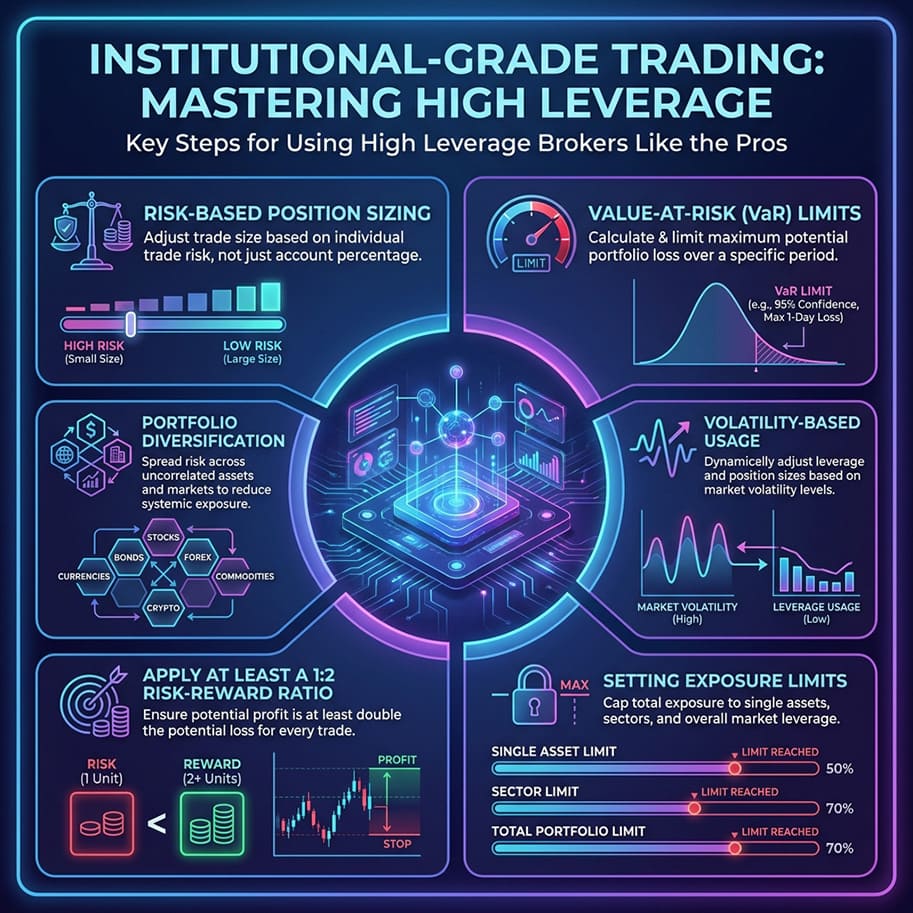
Institutions do not simply place outsized trades because they have access to high leverage. Instead, they use a risk-based approach to position sizing. This approach watches market volatility and drawdown limits among risk factors.
What is Value-at-Risk? Values-at-Risk are limits set on trading capital, clearly stating how much capital or buying power can be deployed in a day or a week. For instance, if a trader has 1,000 times buying power (i.e., 1:1000 leverage), which gives a $1,000 account up to $1,000,000 in buying power, a daily VaR can limit the usable buying power for the day to a quarter of that amount. Any breach would trigger a circuit breaker, instantly cutting off the trader's market access.
The essence of portfolio diversification is to spread risk. This is one area where high leverage is actually an advantage. The high buying power can allow you to spread trades across several assets, even while pushing the limits of risk tolerance.
Leverage should be adjusted based on the asset's volatility. Lower the leverage on high-volatility assets such as gold, Bitcoin, and the Nasdaq 100, while deploying higher leverage on assets like the EUR/USD, which have a narrower range of movement.
Only use high leverage in trades where the reward exceeds the risk. In real trading terms, it means chasing trades with a risk-reward ratio of 1:2 and above.
Limiting exposure in high-leverage FX accounts is a good way to give your account capital enough room to manage any faltering trades. With low leverage, such capacity is limited. Institutions typically have exposure limit policies that restrict the leverage they can use between 20% and 30%. This leaves the account with excess liquidity, preventing margin calls or forced liquidations.
High-leverage brokers allow for a diversified spread on the assets that can be traded. You can set up multiple trade positions to take advantage of profitable scenarios across asset classes. So if you had access to $10,000 in capital, would you rather commit a third of it into a low-leverage, high-margin platform where you may only be able to take one trade at a time with no recourse to hedge that trade using another position, or would you rather use a much lower portion of your capital on a high-leverage broker and can set up a second or third trade that provides a cover in the event the initial trade goes bad?
Bismarck is a trader who has chosen to use a 1:500 leverage to trade on a capital of $10,000. This gives him the purchasing power of $5,000,000. He chooses to allocate this buying power strategically to positions based on his risk-reward analysis and does not try to chase one big bumper trade on full margin. This approach uses a high-leverage facility backed by proper risk control.
Joan is an experienced forex trader who uses a leverage ratio of 1:1000 to trade with a $10,000 capital. This gives her a buying power of $10m. But she opts to open a position using only 1% of this buying power in a low-volatility currency pair. Her strict control ensures that she never risks more than $100,000 of buying power in a trade, which actually uses only $100 of her $10,000 capital. Even if she loses the trade, she still has $9,900 to work with.
The case study below illustrates the dangers of using high leverage forex brokers. Again, it must be said that the danger does not lie in the brokers themselves, but in the traders' use of high leverage. Case Study 3: Overexposure and poor risk management: the wrong use of high leverage
Tadic's inexperienced handling of the 1:1000 leverage he chose for his $2,000 capital is a classic example of how not to use high leverage. He had options to use 1:500, but he opted not to. With $2,000,000 in buying power, he opted to use half of it (essentially half of his capital) in a trade. However, a news event caused the market to move against his position, and he lost half his account. His poor risk management and overexposure of his account were the reasons his high-leverage playbook failed him.
Moving on, we present a list of brokers that offer leverage up to 1:3000. However, a clarification is in order. The leverage you see listed next to each broker is the maximum available to you as a trader. The leverage provided by these brokers spans a range from 1:2 to 1:500, 1:2000, or 1:3000, as the case may be. This gives you the power to choose leverage amounts you are comfortable with. If you are more comfortable using a leverage of 1:200 (i.e., a margin of 0.5%) rather than very high leverages (such as 1:3000), by all means, work with this. The best high-leverage brokerage companies put the power of choice in your hands without boxing you into a corner with very few leverage options.
Some of the brokers on this list are offshore branches of brokerages whose head offices are in the UK or the European Economic Area (EEA). These branches offer the same protections and trade conditions as the parent companies. They were created to cater to traders who had to exit UK/EU platforms because they could not meet the steep margin requirements there. In such scenarios, benefits are seen by both brokers and traders: brokers can retain their clients, and traders can continue working with the brands they are used to without having to make major adjustments when trading on new platforms.
Answer: The highest available leverage from high leverage forex brokers is 1:3000.
Answer: 1:1000 carries a higher level of risk than lower leverages, but this is a risk that can be managed using the tools and methods mentioned above so that the double-edged sword of leverage can work in your favor.
Answer: Technically speaking, 1:30 leverage may appear to be safer than 1:1000 leverage on paper. But a look at the broker disclaimers, which ESMA has mandated that EU and UK brokers display on their home pages, shows that the use of 1:30 leverage has not translated into higher win rates for their clients. There are other risk management considerations, and the overall application of risk and leverage is what matters.


