
Published: November 11th, 2026
XRP's non-profit overseer, the XRP Ledger Foundation (XRPLF), says it's ready to shield crypto traders against quantum computing-led hacks by allowing digital asset holders to replace existing cryptographic keys.
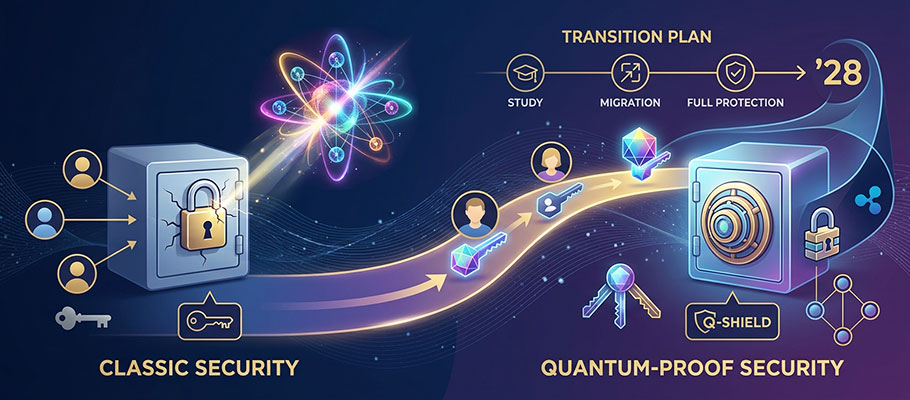
The proposed design would give XRP users the ability to swap a new quantum-proof signing key for their old one, closing a potential security vulnerability as quantum technology advances. The initiative is part of a series of XRPLF's proposals for the protocol in 2027. It says the changes will not add to XRP transaction costs.
The vulnerability stems from how blockchain transactions work. Whenever a transaction is signed by an XRP Ledger account, it uses a public key that the network needs to verify the owner's authority. With enough processing horsepower, a future quantum computer could pinpoint that information and use it to calculate the associated private key, giving it control over the user's account.
The proposed migration would replace the existing signing mechanism with a US federal government blockchain signature standard adopted in 2024. Once the new key is installed, users could decommission the previous one, removing the potential vector for attack.
The change does come at a computational cost. Moving to the new standard would take up around 3,700 bytes per payment, versus just 100 currently. XRPLF also expects storage requirements to nearly double. Despite that, account holders won't face higher fees.
Under the plan, operators would be expected to shoulder any new storage requirements. The plan leaves the current base transaction fee untouched, and other XRP transaction fees are burned by the network.
Several technical questions remain unresolved. Developers are working through an issue that allows the current software model to churn up more than one key from a user's unique account identifier.
The Foundation expects development to start in earnest by late 2027. XRP owner Ripple has said it aims to finish its quantum-resistance phase-in over the next 18 months.
The XRP Ledger's preparations reflect growing interest across the cryptocurrency industry in the long-term implications of quantum computing. Developments in the field are attracting attention from researchers and investors, even as the technology remains some distance from threatening established cryptographic systems.
Earlier this year, IBM expanded free access to its quantum computers through its cloud-based Quantum Open Plan. The changes include higher runtime limits, additional training resources and access to a more advanced processor.
Researchers who use 20 minutes of computing time within a year can qualify for a promotional allocation of 180 additional minutes over the following 12 months.
The expansion gives a broader pool of researchers opportunities to experiment with actual quantum hardware. It also supports IBM's ambition to build an ecosystem of developers and scientists capable of exploiting more powerful machines as they become available.
The company has made several advances towards that goal. In October 2025, IBM researchers demonstrated a 120-qubit entangled "cat state", showing progress in coordinating quantum bits across larger systems. The company subsequently unveiled its 120-qubit Nighthawk processor and reaffirmed its ambition to achieve quantum advantage, the point at which quantum computers outperform conventional machines on useful tasks.
The milestones are significant, though qubit counts alone offer an incomplete measure of progress. Quantum systems are highly susceptible to environmental interference, or noise, which introduces errors and limits the complexity of calculations they can perform.
For crypto traders, the eventual arrival of sufficiently powerful quantum computers presents a worrying security threat. Bitcoin and several other blockchain networks rely on elliptic curve cryptography to establish ownership of digital assets. In theory, a quantum computer running the appropriate algorithm could derive a private key from its corresponding public key, allowing an attacker to steal the funds it controls.
This possibility has encouraged discussion of a scenario known as "harvest now, decrypt later". An attacker could collect exposed cryptographic information today and retain it until quantum technology becomes powerful enough to exploit it.
The prospect sounds alarming. Most assessments, however, place the immediate threat well beyond the capabilities of current machines.
A recent report by Ark Invest argued that existing quantum computers remain far from being able to compromise Bitcoin's cryptography. The report also suggested that meaningful advances would have implications for internet security more broadly, prompting responses from governments, technology companies and financial institutions alongside cryptocurrency developers.
Ark's analysis challenges the idea of a sudden "Q-day", when quantum computers abruptly make existing encryption obsolete. The more plausible scenario involves a gradual improvement in computational capabilities, giving institutions and blockchain networks time to develop replacement systems.
Quantum computing is also unlikely to develop at the same pace across every field. Chemistry and materials science are expected to provide some of the earliest practical applications, since certain problems in those disciplines may be tackled with less stringent error-correction requirements.
Cryptographic attacks would require more advanced systems. Even then, the threat could emerge incrementally, with initially slow and impractical attacks becoming progressively faster as hardware and algorithms improve.
For Bitcoin, one important theoretical threshold would be the ability to derive a private key quickly enough to exploit the time between transactions and block confirmations. Bitcoin's ten-minute average block interval provides a useful reference point, although the practical requirements for an attack would depend on how the network's security and transaction processes evolve.
The XRP Ledger's proposed migration offers an early example of how blockchain developers might approach the problem. Its design gives account holders a route to replace vulnerable keys while keeping the network's existing fee structure intact.
The challenge will be implementing that transition safely, testing its performance and ensuring users understand what they need to do. Quantum-resistant cryptography brings its own technical and operational costs, including larger signatures and additional storage requirements.
The deadline may still be distant. The engineering work required to meet it is already on the roadmap.


