
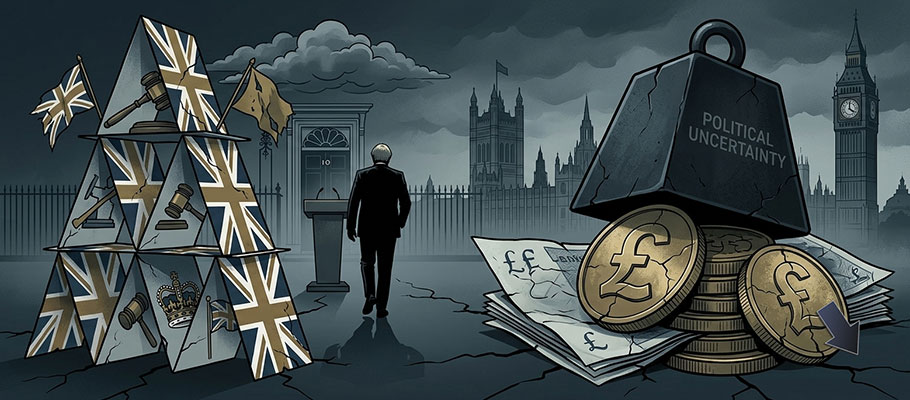
British Prime Minister Keir Starmer announced his resignation on Monday 22nd June, bringing weeks of speculation to an end and setting in motion a leadership contest that could reshape Britain's economic agenda.
Speaking outside 10 Downing Street, Starmer said he would stay in office until a successor is chosen. Labour plans to begin the formal leadership process by July 9, with a replacement expected before Parliament returns in September.
Forex markets responded cautiously. Sterling slipped to its lowest level against the Euro since mid-May, before regaining some ground on Tuesday. Currency strategists said investors were less concerned by the PM's departure itself than by the prospect of prolonged uncertainty over fiscal policy and economic management.
A note from Commonwealth Bank said elevated political risk was likely to keep pressure on Sterling in the near term, particularly against the dollar. HSBC similarly warned that political and budgetary uncertainty could continue to weigh on British assets generally.
Attention has already shifted to Andy Burnham, the former mayor of Greater Manchester, who is widely expected to emerge as Labour's next leader and therefore Britain's next prime minister. His ascension will mark the country's 5th change of PM in six years.
Reports suggest Burnham enjoys overwhelming support among Labour MPs and could assume the leadership with minimal opposition. Allies argue that a costly and divisive contest would serve little purpose. Critics counter that the absence of a meaningful challenge would deprive voters, markets and even Labour members of a detailed examination of his plans.
Burnham has yet to outline a comprehensive programme for government. Reports indicate that key questions, including the composition of his cabinet and the identity of his chancellor, remain unresolved.
Political transitions usually mean less to FX traders than fiscal policy. Whoever is in charge, Britain's next government will be judged mainly on whether it can maintain credibility while supporting economic growth.
The most important appointment Burnham will make is Chancellor of the Exchequer. Speculation already surrounds the future of Rachel Reeves, whose position looks tenuous.
Potential replacements carry very different signals. Any appointment perceived as favouring higher borrowing, looser fiscal discipline or a more interventionist state would be closely scrutinised by investors.
Britain's recent history explains why. The bond market has become a powerful constraint on governments of all political persuasions. The turmoil following Liz Trusss' 2022 mini-budget remains a reminder that fiscal credibility can disappear quickly and prove costly to regain.
Throughout his political career, Burnham has advocated a more active role for the state in economic development. His proposals have included greater public investment, expanded regional spending and a larger role for government in delivering key services.
Britain's fiscal rules, however, require public debt as a share of national income to be falling over the medium term. At the same time, tax levels are already near post-war highs, economic growth remains subdued and public services continue to demand additional funding.
That creates a familiar dilemma. Any government looking to spend significantly must either borrow more, tax more, or spend less on other things.
Mr Burnham has at times appeared willing to challenge prevailing fiscal orthodoxy. In a previous interview, he argued that governments should not become excessively constrained by bond markets when pursuing investment-led growth. More recently, he has softened that position, emphasising that financial markets cannot simply be ignored.
The prospect of several months of political uncertainty has prompted comparisons with Labour's first summer in office.
In 2024, much of the government's early messaging focused on the difficult state of the public finances and the possibility of future tax increases. Business confidence weakened as firms delayed investment decisions while waiting for greater clarity.
Few economists would argue that politics alone stalled the economy. Yet uncertainty undoubtedly contributed to a more cautious corporate mood. A similar dynamic could emerge again.
Businesses planning investments, hiring decisions or long-term projects may prefer to wait until the contours of the next administration become clearer. Households, already facing a challenging economic backdrop, may likewise adopt a more cautious stance.
If borrowing remains constrained and spending cuts remain politically difficult, attention inevitably turns to taxation.
Several policy ideas associated with figures close to Mr Burnham would imply a significantly larger role for the state. Proposals discussed in recent years include higher taxes on wealth and investment income, increased levies on energy producers, tighter regulation of financial services and expanded public ownership in selected sectors.
Supporters argue such measures would create a fairer economy while funding essential investment. Critics contend they would discourage entrepreneurship, reduce investment and weaken long-term growth.
The debate isn't new. The United Kingdom has wrestled for decades with the question of how much economic dynamism it is willing to sacrifice in pursuit of redistribution.
What is new is that markets currently have little indication of where a Burnham administration might ultimately land.
Currency traders are often portrayed as making grand judgments about a country's future. In reality, they frequently focus on a simpler question: what is likely to happen next? At present, the answer for the UK is unclear.
Investors do not yet know who will manage the Treasury, whether fiscal rules will be modified, how ambitious any new spending plans might become, or whether taxes will need to rise to fund them. Until those questions are answered, GBP may struggle to attract sustained enthusiasm.
That does not mean markets expect a crisis. Britain's institutions remain strong, its fiscal rules remain in place and any incoming prime minister will quickly discover that governing imposes constraints that campaigning does not.
The coming weeks will reveal whether PM-in-waiting Burnham intends to reassure investors by embracing continuity or persuade them that a more activist economic model can coexist with fiscal discipline. Until then, GBP looks likely to become a barometer of Britain's political transition.


