
Published: May 20th, 2026
In its latest monthly assessment, Australia/New Zealand banking giant Westpac said the New Zealand Dollar is being held back by tepid domestic activity and by the island nation's position as a net importer of energy.
Although NZD has shown surprising resilience against the US Dollar this year, Westpac expects it to remain subdued until both geopolitical uncertainty and local economic slack begin to fade.
The Kiwi it has edged modestly higher against the Greenback in 2026; a respectable performance at a time when the Dollar has been broadly stable. But appearances may mask a deeper truth.
Gains against the US Dollar obscure a much weaker performance against its closest G10 counterpart. Against the Australian dollar, NZD has fallen to a 15-year low, a reminder that currencies are often best judged against their nearest neighbours rather than against the world's reserve currency.
For New Zealand's exporters and importers, a weaker Kiwi against the Australian Dollar raises the cost of imports from New Zealand's largest trading partner and underscores a widening divergence between the two economies.
AUD has benefited from the country's firmer growth and from its status as a major exporter of energy, notably liquefied natural gas. New Zealand, by contrast, imports much of the fuel it consumes. When geopolitical tensions push oil and gas prices higher, Australia gets an income boost while New Zealand gets a larger bill.
That distinction has become more important as conflict involving Iran has rattled commodity markets. Westpac argues that the resulting terms-of-trade shock is more negative for New Zealand than for Australia and is likely to keep the Kiwi in check until uncertainty subsides.
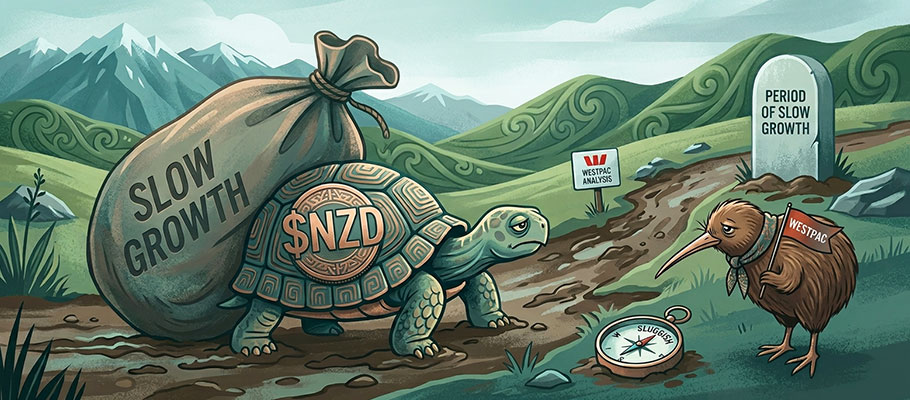
Westpac's broader argument is that New Zealand's economy is recovering, but slowly, and after a prolonged period of stagnation.
Growth remains soft. Spare capacity is still abundant. Businesses have little pricing power, and employers have little reason to bid aggressively for workers. In those conditions, a currency rarely attracts enthusiasm from forex traders.
The unemployment rate unexpectedly dipped to 5.3% in the March quarter, but the details were less encouraging than the headline implied. Employment rose by only 0.2%, below expectations, while the participation rate slipped to 70.4%. Fewer people were looking for work, helping to lower the unemployment rate.
Broader indicators painted a similarly subdued picture. Underutilisation remained high at 12.9%, and the proportion of young people not in employment, education or training rose sharply.
Wage growth exceeded expectations by a small margin, with private-sector costs rising 0.5% over the quarter. But annual wage growth stayed put at just 2%, a pace consistent with an economy operating below capacity than one in danger of overheating.
The Reserve Bank of New Zealand (RBNZ) is charged with maintaining price stability. Higher oil prices can lift inflation temporarily, but policymakers are usually more concerned about whether such shocks spill into wages and broader domestic prices.
Financial markets have become more alert to the possibility that the RBNZ could tighten policy if energy-driven inflation proves persistent.
Following recent data, investors assigned a meaningful probability to a rate increase at the bank's next meeting. Further tightening by July is fully priced, with another move by September seen as highly likely.
But unless higher fuel prices stabilize at current levels for many months, the case for tighter policy is weak. Demand remains subdued and the labour market retains considerable slack. Temporary inflation shocks are uncomfortable, but central banks usually prefer to look through them when domestic conditions are fragile.
The bank's Survey of Expectations, which tracks professional forecasters' inflation outlook, will therefore be watched closely. In February, two-year inflation expectations stood at 2.37%, comfortably within the Reserve Bank's 1% to 3% target range.
A modest increase would not necessarily alarm policymakers. It would likely take a far sharper rise to persuade the central bank that immediate action is required.
Westpac expects the New Zealand dollar to play its customary role as a shock absorber, where a weaker exchange rate cushions the economy by making exports more competitive. This may be uncomfortable for importers, but it is often preferable to a deeper slowdown.
That mechanism is particularly useful for a small, open economy exposed to swings in commodity prices and global risk sentiment. The drawback, of course, is that imports become more expensive. But with domestic demand soft, businesses may struggle to pass on all those costs to consumers.
Westpac's analysts aren't entirely pessimistic. Over the medium term, the bank believes a weaker U.S. dollar should lend support to the kiwi. The greenback remains overvalued in Westpac's view, and any broad decline would help currencies such as the New Zealand dollar recover.
For now, New Zealand faces a familiar combination of mediocre growth, lingering spare capacity and heightened global uncertainty. None is especially supportive of the currency. Westpac expects the New Zealand dollar to remain broadly stable against the U.S. dollar, forecasting NZD/USD at 0.59 by both mid-year and year-end.
The bank sees the pound buying NZ$2.27 by mid-year and NZ$2.33 by the end of the year. The euro is expected to trade near NZ$2.00 over the same period.
The Kiwi has shown more resilience than New Zealand's economic fundamentals might suggest. But resilience should not be mistaken for strength.
The country is still caught between weak domestic momentum and external shocks beyond its control. Australia enjoys stronger growth and the benefits of higher energy prices. New Zealand gets the inflation but not the windfall.
For investors hoping for a sustained rally, that is a sobering reality. NZD may not be in free fall, but if Westpac is right, it is likely to spend some time in the doldrums.


