
Published: October 28th, 2026
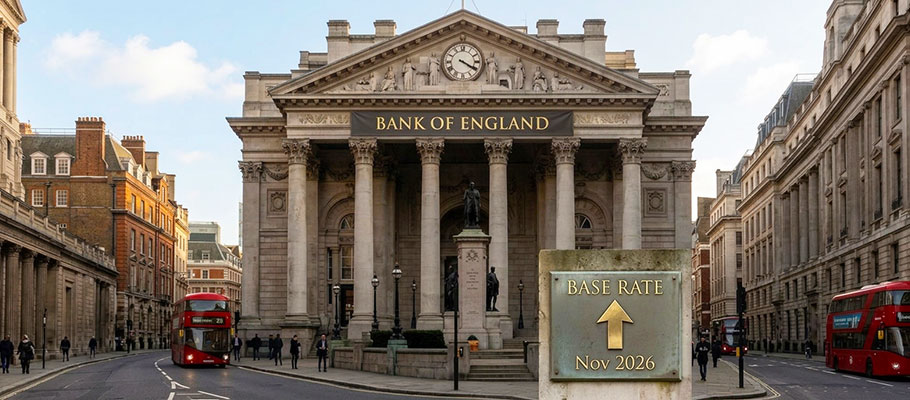
Expectations are growing for a Bank of England interest-rate increase on November 5, with Barclays and ING joining the camp forecasting a hike as stronger inflation and labour-market data strengthen the case for tighter policy.
Pantheon Economics also sees a third rise, potentially as early as April, while several other research houses expect rates to rise again in February. Money markets have gone further, pricing in a roughly 100 basis-point tightening over the next 12 months, which would see a Bank Rate set at 4.75%.
The shifting concensus follows September's higher-than-expected inflation reading and a surprise dip in unemployment. Persistent energy-price pressures have added to concerns that inflation will remain elevated, even as the Bank weighs the risks of restraining an economy that has proved more resilient than expected.
Barclays said it now expects a November increase as stronger activity and signs of labour-market stabilisation heighten inflation risks. ING is looking for hikes in November and February, describing that path as more dovish than current market pricing.
Société Générale considers an increase to 4% on 5th November all but certain, with additional tightening priced through to July 2027 unless inflation moderates or economic resilience fades.
The bigger disagreement concerns what happens next. Markets are anticipating a substantial tightening cycle, while several banks argue that weaker demand, limited real-wage growth and impending fiscal restraint will restrict the Bank's appetite for successive increases.
The latest prints have strengthened the case for action. ONS figures put September consumer-price inflation at 3.5% year-on-year, up from 3.2% in August. Inflation in the services sector hit 3.7%, while core inflation reached 2.8%.
Underlying measures of price pressure were less reassuring. Annual services inflation, excluding some volatile components, moved to 3.9%, its highest level since March, while growth on a three-month timescale sped up to 4.3% from 3.5% in August. The numbers suggest domestic price pressures remain stubborn even as policymakers look for signs that inflation is returning towards target.
Oxford Economics has upped its forecast for peak inflation to 4.7% in February, from 4.5%, reflecting higher wholesale energy prices. It expects inflation to hold north of 4% between now and July.
The labour market has also surprised on the upside. Unemployment dropped to 4.6%, less than expectations of 5%. Normal pay growth reached 3.6%. The combination complicates the argument for holding rates steady: a softer labour market might have helped contain wage pressures, but the latest figures offer less reassurance on that front.
UBS sees two increases on the cards in the next half year, arguing that the case for precautionary tightening is gaining momentum as Middle East tensions threaten to delay the normalization of inflation.
Barclays expects two hikes. Deutsche similarly sees a November rise, with the next one likely arriving in Q1 of 2027.
Opinions over the timing and eventual destination of the cycle remain less settled.
Money markets are pricing roughly four quarter-point increases over the coming year, taking Bank Rate to 4.75%. Lloyds Bank says the scale of tightening embedded in prices extends well beyond a single November move, while Societe Generale expects three further increases by next summer if inflation progress stalls.
The Bank's own signals are less accommodating. Its Chief Economist has been skeptical about market pricing, a notable intervention from a member of the Monetary Policy Committee's more hawkish faction. Barclays interprets his comments as a warning against assuming four successive quarter-point increases.
ING also doubts that Threadneedle Street will raise rates by 100 basis points. ING calls expectations for tightening by 100 basis points before July 2027 too aggressive, though its analysts think that a November hike looks likely.
The distinction is important for bond investors and currency traders. A November increase may be largely settled in market prices, leaving the subsequent pace of tightening as the more consequential source of uncertainty.
Oxford Economics offers a more benign inflation outlook, arguing that softening demand and household disposable income stretched thin will prevent companies from rebuilding profit margins through sustained price increases.
The consultancy forecasts consumer-price inflation at 3.5% in the final quarter of this year, falling to 2.5% 12 months after. It expects inflation in import-prices to decline from 4% down to 1%, with 3% growth in unit labour costs. These projections imply that price pressures should ease even as higher energy costs work their way through household bills.
That forecast includes an expected 23% increase in Ofgem's energy price cap in January. Oxford Economics nevertheless considers market pricing of roughly 120 basis points of rate increases by the end of 2027 excessive.
Sterling's immediate support comes increasingly from interest rate expectations. Bank of America adjusted its Sterling outlook to neutral versus the Euro, arguing that favourable developments are already being reflected in prices and that volatility around the coming UK national Budget may be underestimated.
ING sees scope for Sterling to benefit from a more credible tightening cycle, forecasting quarter-point increases in November and February. Higher prospective yields would make the pound a relatively attractive European currency for investors seeking carry, the return earned from holding a higher-yielding currency.
Nomura also sees an uplift to the carry trade and a firmer growth backdrop supporting Sterling, particularly against the Euro. Political uncertainty in France adds to the Euro's difficulties, although the pound remains exposed to domestic fiscal risks.
The range of analyst opinion illustrates the divide confronting markets. Traders are increasingly confident that the Bank will act in November, while economists remain split over whether persistent inflation will justify a prolonged campaign of increases.
For the Pound, the first hike may offer limited surprise. The greater opportunity, and risk, lies in how far the Bank is prepared to follow it.


