
Published: September 23rd, 2026
EUR/USD is stabilizing after last week's Fed-driven selloff. The pair found support near 1.1450 on Tuesday, but the euro still faces a difficult mix of German political uncertainty, high energy costs, and a Federal Reserve that continues to signal tighter policy.
“EUR-USD has stabilized at levels just below 1.15, suggesting that the pair may have found a floor following last week's hawkish Fed meeting,” says a note from Commerzbank's FX and Commodity Research desk.
That assessment fits the price action. EUR/USD fell from 1.1539 to below 1.15 as the Fed raised rates and signalled another increase could follow before year-end. A sustained break below 1.1450 would expose the July low near 1.1320, leaving the euro with considerably less chart support beneath it.
Selling pressure has eased for now. The single currency needs a fresh catalyst to move higher.
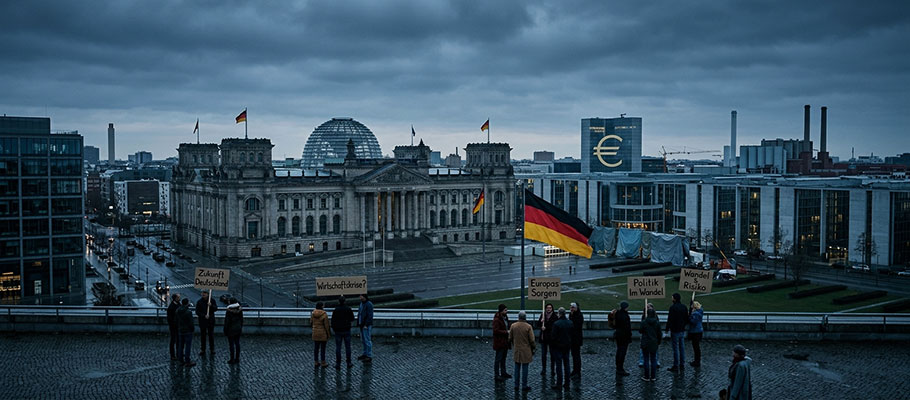
Germany's regional elections have added to the backdrop of uncertainty. The right-wing AfD won the largest share of votes in Mecklenburg-Western Pomerania on September 20, while the left-wing Die Linke party finished first in Berlin.
Chancellor Friedrich Merz's CDU took just 4.9% in Mecklenburg-Western Pomerania, falling below the threshold for representation in the state parliament, and finished second in Berlin. Merz has said he will remain in office and continue his reform programme.
Foreign-exchange issues could impact economic policy. Merz's government has backed higher investment and changes to Germany's constitutional fiscal rules. That spending has been part of the bullish euro argument in 2026, with investors looking for stronger German demand to support the wider eurozone economy.
The election results make the political backdrop less straightforward, but energy prices pose an even more immediate problem.
German wholesale prices rose 6.8% year on year in August, their fastest annual increase since early 2023, with energy among the main drivers. Higher power costs are particularly relevant for Germany's manufacturing-heavy economy.
For the euro, the transmission is familiar. Higher energy costs raise inflation and squeeze demand at the same time. That leaves the ECB balancing price pressures against weaker growth.
The eurozone's dependence on imported energy also makes the currency sensitive to the oil and gas market. Lower energy prices would remove some of the pressure from both European inflation and growth.
The ECB has given the euro a stronger interest-rate backdrop recently. Frankfurt raised its three key rates by 25 basis points on September 10, taking the deposit facility rate to 2.50% from September 16. Analysts at several major banks now expect another increase.
MUFG expects two further 25-basis-point hikes, taking the deposit rate to 3% by year-end. Nomura expects increases in December and March, while UniCredit, Deutsche Bank, UBS and ANZ see one more hike in December. Barclays has also moved towards a December increase after previously expecting September's decision to be the final hike.
Higher oil and gas prices are keeping inflation risks alive, giving the ECB a reason to maintain its tightening bias even as higher costs weigh on growth.
Chief Economist Philip Lane said on September 22 that higher oil and gas prices could keep inflation elevated for longer than previously expected, with inflation returning to target from mid-2027.
The next test comes from the eurozone's purchasing managers' indices on Wednesday. UniCredit expects the composite PMI to fall to 51.5 from 52.0 as higher energy costs weigh on new orders.
A stronger reading would support expectations for further ECB tightening. A weaker figure would put more emphasis on the growth damage from expensive energy.
Upcoming German economic prints, Italy's revised 2025 deficit figures and Moody's review of Italy will provide additional signals on growth and fiscal risk.
The euro also has to contend with the Greenback. The Fed's latest projections signal another rate increase in the fourth quarter, keeping the US interest-rate advantage relevant to EUR/USD and limiting the scope for a sustained euro rally without stronger European data.
Danske Bank expects EUR/USD to fall towards 1.12 over the next 12 months, citing strong US growth, further Fed tightening and elevated energy prices. The underlying drivers are already visible.
Energy prices remain particularly important. Oil has fallen for several consecutive sessions as diplomatic efforts involving Iran have reduced some supply concerns, according to Julius Baer. A sustained decline would offer the eurozone some relief.
Germany's growth outlook provides a second counterweight. German economic institutes have raised their forecasts for growth to 1.3% in 2026 and 1.1% in 2027. They also expect momentum to weaken in the second half of the year as high energy costs and subdued investment weigh on activity.
That leaves EUR/USD caught between two competing forces: an ECB that has become more willing to tighten because inflation remains uncomfortable, and an economy that may find the resulting policy increasingly difficult to digest.
The immediate technical picture remains straightforward. EUR/USD is holding above 1.1450, with 1.1500 the first resistance area. A break below support would put the July low near 1.1320 back on the radar.
The fundamental picture, however, is less supportive of a sustained recovery. The European Central Bank can still provide rate support if inflation remains elevated. Upcoming inflation data will show whether the eurozone economy can absorb the energy shock without losing too much momentum.
Events in Germany remain central to that calculation. Political uncertainty has complicated the fiscal-growth story, while high prices for oil, gas, and electricity are adding pressure to an economy that remains heavily exposed to the manufacturing sector's ups & downs.
For a stronger recovery, the euro needs either better European growth data, lower energy prices or a less supportive dollar. For now, none of those is guaranteed.


