
Published: August 5th, 2026
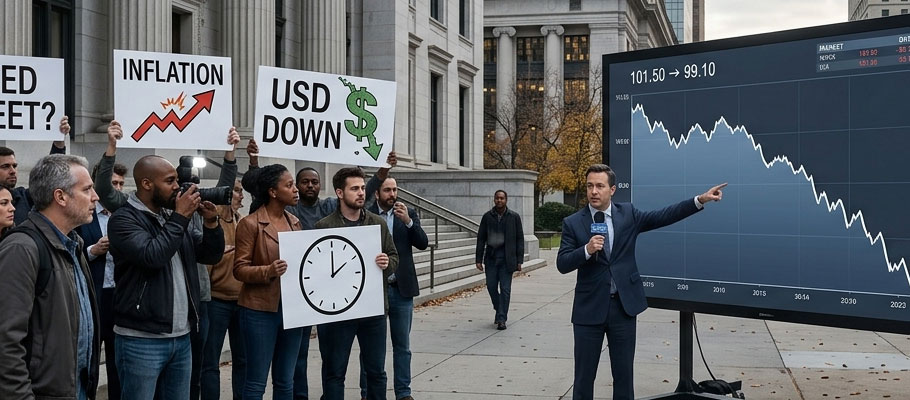
The Greenback retreated sharply on Tuesday after the US Federal Reserve signaled no immediate appetite for higher interest rates, prompting investors to reassess the path of monetary policy and pushing expectations for the next increase into October.
Markets interpreted comments from Chairman Kevin Warsh at post-meeting press conference as a dovish surprise. The central bank left rates unchanged after its latest meeting, while Warsh expressed confidence that price stability would eventually return, though without a clear roadmap for further tightening.
Reaction was swift. Sterling rose 0.6% against the dollar to close at 1.3367, while the euro climbed 0.7% to 1.1466. The dollar index also weakened as traders concluded that the Fed had become less willing to translate hawkish rhetoric into policy action.
Warsh argued that higher long-term market yields since June had already tightened financial conditions and had therefore done part of the Fed's work. The remark landed awkwardly, and some analysts are wondering whether the chairman was suggesting that market forces had reduced the need for further policy action.
A note from Commonwealth Bank argued that traders are growing concerned about the Fed's inflation-fighting credibility. Financial conditions may tighten through higher bond yields, but that's not the same as a central bank demonstrating policy discipline until inflation returns to target. The former can occur despite the Fed; the latter requires that it take deliberate action.
Crédit Agricole noted that Warsh's comments sounded less hawkish than many had anticipated. The implication was that the Fed may be leaning on market pricing rather than leading it.
Before the meeting, many traders expected a rate increase in September. Afterward, futures markets shifted that expectation to October. The dollar's strength over the past several years has rested heavily on the assumption that US interest rates would remain higher than those of most developed economies for longer.
Any sign that the Fed is becoming more cautious narrows that advantage, particularly against currencies where investors have built up substantial short positions.
Investors now have to grapple with a more nuanced question. If inflation remains elevated and the Fed still refuses to move, what exactly is the threshold for action?
That warning captures the tension facing the central bank. Leaving rates unchanged while inflation stays above target may tighten financial conditions through higher yields, but it does not automatically strengthen the dollar. Confidence in the currency ultimately depends on confidence in the institution behind it.
The euro has been one of the clearest beneficiaries of USD's retreat, but the rally is approaching a decisive technical test.
EUR/USD broke above former resistance of around 1.1447 on Tuesday and recovered sharply from its July lows. The move has improved momentum considerably, with the relative strength index climbing to 63, its strongest reading in weeks.
The pair is now challenging the descending trendline that has capped advances since January, while also approaching the 100-day moving average near 1.1569. Together, those levels could form a formidable zone of resistance.
For traders, the issue is whether buyers can generate enough momentum to turn a rebound into a broader trend reversal.
After such a rapid advance, some consolidation beneath resistance would be seen as a healthy development. A failure to push through current levels would suggest that the dollar's weakness remains primarily a positioning adjustment. A decisive break above the trendline would imply that the market is beginning to price a more meaningful shift in US monetary expectations.
The dollar also weakened sharply against the Japanese yen after an unusually explicit confirmation of coordinated market intervention by Washington and Tokyo.
Before late last week, the dollar had traded above ¥163, reaching levels not seen in four decades. Following suspected intervention, it fell below ¥160. After President Donald Trump and Japanese Finance Minister Satsuki Katayama publicly acknowledged coordinated action, the exchange rate dropped to around ¥155.20 before stabilising near ¥156.70.
That sort of public confirmation is rare, as governments often prefer ambiguity when intervening in foreign-exchange markets. The last widely cited example of similarly coordinated action came after the 2011 earthquake and tsunami in Japan.
Tokyo's frustration is understandable. A weak yen raises the cost of imports in a country that depends heavily on imported energy and raw materials. Higher oil prices have amplified the pressure on households and on the government of Prime Minister Sanae Takaichi.
Yet intervention can only address symptoms, not root causes. The fundamental driver of yen weakness remains the large interest-rate gap between the United States and Japan. Both the Bank of Japan and the Federal Reserve left policy rates unchanged last week, preserving that differential.
Unless the gap narrows through either Fed easing expectations or Japanese tightening, intervention alone is unlikely to produce a lasting reversal.
For now, the dollar is paying the price for uncertainty on future central bank policy action. The Fed is still talking tough on inflation, and Warsh still insists that price stability will be achieved. US rates are still well above those in Japan and other G10 economies.
What has changed is the market's confidence that words will be followed by action. Forex traders tend to be unforgiving when central banks outsource policy tightening to bond markets. The dollar's decline reflects a reassessment of resolve as much as a reassessment of rates.
That leaves the greenback vulnerable in the weeks ahead. If incoming inflation data remain firm and the Fed continues to stand still, questions about credibility will grow louder. If the central bank signals a willingness to tighten again, the recent sell-off could reverse quickly.
In foreign exchange, signs of conviction can matter as much as policy itself. At the moment, investors seem less certain that the Federal Reserve possesses enough of either.


