
Published: June 3rd, 2026
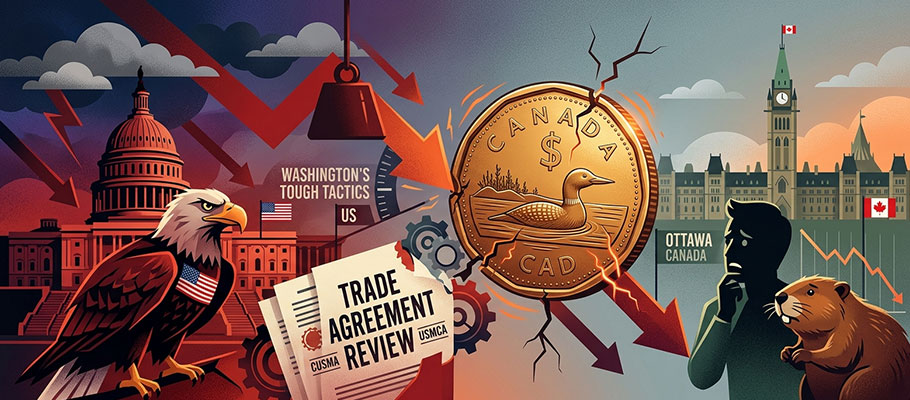
Canada's currency is entering a critical stretch as remarks by US Trade Representative Jameson Greer this week set the stage for tough negotiations over the future of the United States-Mexico-Canada Agreement (USMCA).
Speaking ahead of talks in Mexico, Greer noted that Canada occupies a "different spot" from its southern neighbour because it has chosen to retaliate against American tariffs. Alongside China, Canada remains one of the few countries to have responded in kind. Ottawa may face a more difficult path as a result.
Under the USMCA implementation framework, the White House must present recommendations to Congress ahead of the agreement's July sunset review. For foreign-exchange markets, that process is increasingly becoming a source of risk. While both the Canadian dollar and Mexican peso are exposed to trade developments, recent signals suggest the burden may fall more heavily on Canada.
The Canadian dollar has spent much of the year navigating a complicated mix of domestic weakness and external uncertainty. Trade tensions now appear to be moving back to the centre of investors' attention.
A strategy note from Société Générale observed that although speculative bearish positions in the Canadian dollar have been reduced, pessimists still retain the upper hand. Falling oil prices have removed one source of support, while Greer's comments have revived concerns over Canada's trading relationship with its largest export market.
Currency strategists at CIBC Capital Markets highlighted a similar trend. The loonie has weakened against the greenback in 17 of the past 20 trading sessions, a decline they partly attribute to growing uncertainty surrounding the approaching USMCA negotiations.
That performance reflects the broader reality that traders can tolerate bad news when it is predictable, but struggle with uncertainty. The prospect of renewed trade disputes creates precisely the sort of ambiguity they tend to dislike.
Roughly three-quarters of Canada’s country's exports are destined for the United States. Even modest disruptions to that relationship can have outsized economic consequences.
Trade politics are not the only challenge facing the Canadian dollar this week. Traders are also preparing for Canada's latest labour-market report due on Friday. Economists expect a modest increase in employment alongside an unemployment rate near 6.9%.
Under normal circumstances, resilient job creation would be viewed as supportive for the currency. A robust labour market can sustain wage growth, strengthen consumer spending and increase the risk of inflationary pressures. That, in turn, can encourage expectations of tighter monetary policy.
A stronger-than-expected report could reinforce concerns that inflationary pressures remain stubborn, forcing the Bank of Canada to maintain a hawkish bias. That outcome would likely provide some support for the currency.
A weaker report would tell a different story. Evidence of labour-market softening would suggest the economy is losing momentum and reduce the urgency for future policy tightening. In that scenario, investors could become more willing to favour currencies backed by central banks perceived as more likely to raise rates.
Some analysts argue that Canada's challenges extend beyond the latest economic data release. A note from Spectra Markets adopts a bearish stance toward the Canadian dollar, citing a combination of restrictive immigration policies, ongoing U.S. tariff pressures and a weakening housing market.
Housing occupies a uniquely important position within the Canadian economy. For years, rising property values helped support household wealth, consumption and confidence. The reverse process can be equally influential.
If house prices continue to soften, the consequences may extend beyond the property sector itself. Lower housing activity affects construction, lending, consumer spending and government revenues. The cumulative effect can become a meaningful drag on growth.
What makes this argument noteworthy is not that it identifies risks, but that it suggests markets may not yet be fully pricing them. Currency moves often become more pronounced when investors shift from ignoring a problem to recognising it.
Trade uncertainty is unfolding against a crowded global monetary-policy backdrop. Nine of the G10 central banks are scheduled to meet in June, making it one of the busiest months of the year for policymakers. The only exception is the Reserve Bank of New Zealand.
According to analysts at MUFG, the European Central Bank and the Bank of Japan appear the most likely candidates to deliver rate increases. Market pricing and recent official communications suggest both institutions remain concerned about inflation credibility.
The US Federal Reserve is not expected to alter rates at its June meeting. Nevertheless, investors will closely watch the first post-meeting press conference under Chair Kevin Warsh.
The broader backdrop remains unusually sensitive to geopolitical developments, particularly developments affecting global energy markets. Any reduction in tensions and a normalisation of energy flows would likely allow policymakers to place greater emphasis on underlying inflation measures rather than temporary commodity-price shocks.
The Canadian dollar finds itself caught between several competing forces. Trade uncertainty is resurfacing just as economic momentum appears to be slowing. Housing remains fragile. Labour-market data may reveal further cracks in domestic demand. At the same time, interest-rate differentials continue to favour the US dollar.
MUFG notes that USD/CAD has gained more than half a percentage point over the past week, supported by the relative attractiveness of US yields and a Bank of Canada that remains cautious rather than aggressively hawkish.
None of this guarantees sustained Canadian dollar weakness. Currency markets can reverse quickly when sentiment changes, yet the balance of risks appears to have shifted. For much of the year, CAD traders have focused on interest rates and commodity prices. Increasingly, they are being forced to consider politics as well.
That is rarely a comfortable combination for a small open economy whose prosperity depends heavily on access to its largest trading partner. As the USMCA review approaches, the loonie bulls may discover that trade uncertainty has stepped out of the background to become a central part of the story.


