
Published: July 15th, 2026
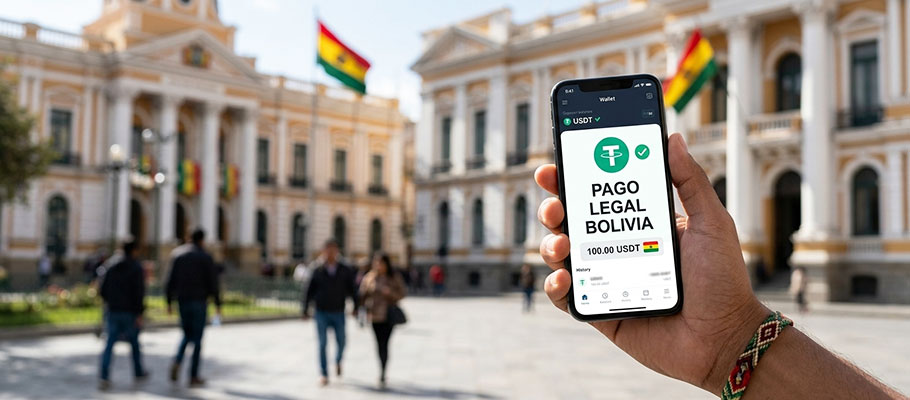
Bolivia is preparing to recognise Tether's USDT stablecoin as a legal form of payment, marking another step in its reversal of a once restrictive stance on cryptocurrencies.
Speaking to journalists this week, Economy Minister José Gabriel Espinoza Yáñez said officials are drafting regulations governing crypto assets while assessing how USDT should be incorporated into Bolivia's National Payments System. He stressed that any decision would move forward cautiously given Bolivia's recent placement on America's Financial Action Task Force's grey list.
"We are writing new rules to strengthen Stablecoin adoption by assisting citizens who have adopted them, in many cases out of necessity, learn how to use them in the right way," Espinoza Yáñez said, according to reports in Bolivia's La Razón national newspaper.
The proposal reflects a broader shift in Bolivia's approach to digital assets. The country lifted its ban on cryptocurrency transactions in 2024, financial institutions have begun offering crypto-related services, and stablecoins are increasingly seen as practical payment tools rather than instruments for retail speculation.
Few countries have changed course on cryptocurrencies as quickly as Bolivia. For years, it effectively excluded digital assets from the financial system. Today, policymakers are exploring how one of the world's largest stablecoins might fit back in.
Officials say oversight will be critical. Bolivia's inclusion on the FATF grey list means its anti-money laundering and counter-terrorist financing framework remains under extra scrutiny. Any formal role for crypto assets will need tough safeguards that satisfy both domestic regulators and international watchdogs.
The government also argues that the economy has begun to stabilise after recent policy changes, creating room to modernise parts of the financial system. Whether that assessment proves durable remains uncertain. Even so, policymakers appear increasingly willing to treat digital assets as financial infrastructure rather than a regulatory anomaly.
Bolivia's interest centres on USDT rather than cryptocurrencies such as Bitcoin or Ether. That distinction matters.
Unlike conventional cryptocurrencies, stablecoins are designed to minimise price fluctuations by tracking an external asset. USDT is pegged to the US dollar and has become the dominant settlement currency across much of the crypto economy. Traders use it to move capital between exchanges, businesses use it for cross-border settlements, and households increasingly rely on it where access to dollars is constrained.
This practical utility has broadened stablecoins' appeal well beyond crypto enthusiasts. In many emerging economies, they function as an informal substitute for scarce foreign currency, allowing users to preserve purchasing power and move money internationally without exposure to crypto market volatility.
Supporters view that combination as one of blockchain's most useful financial applications. Critics continue to question reserve transparency, regulatory oversight and the concentration of influence among the largest stablecoin issuers.
Bolivia's changing stance mirrors wider trends. Latin America is now one of the world's fastest-growing crypto markets. Chainalysis estimates the region processed nearly $1.5 trillion in cryptocurrency transactions during the three years ending in June 2025, driven by remittances, inflation, cross-border commerce and demand for dollar-denominated assets.
Bolivia remains a relatively modest participant, yet activity has accelerated since restrictions were lifted. Between July 2024 and June 2025, the country recorded roughly $14.8 billion in crypto transactions, placing eighth among Latin American markets and ahead of Ecuador and Puerto Rico.
Banks have begun responding to that demand. In October 2024, Banco Bisa introduced custody services allowing customers to hold and transfer USDT, primarily for international transfers and supporting relatives abroad. What began as a niche custody offering could eventually evolve into broader integration with the country's payments infrastructure.
Bolivia's deliberations coincide with Tether's broader expansion across Latin America. On 7 July, the company announced a $20 million investment in Brazilian exchange Mercado Bitcoin, supporting the expansion of blockchain-based financial services across the region.
Mercado Bitcoin has grown beyond a digital asset exchange into a fully-fledged financial platform offering tokenised investments, lending, payment rails, and banking services. The company says it serves 4.5 million users, has issued more than 2 billion reais in tokenised assets and operates under multiple regulatory licences across Brazil and Europe.
Tether said the partnership reflects its ambition to build more open and efficient financial infrastructure, while Mercado Bitcoin described the investment as support for the next phase of tokenisation, stablecoin payments and on-chain capital markets.
Paolo Ardoino, Tether's chief executive, described the partnership as an investment in financial infrastructure rather than simply another crypto exchange. Roberto Dagnoni, Mercado Bitcoin's chief executive, argued that the debate has shifted from whether finance will move on-chain to how that infrastructure should be built.
The investment will fund expanded payments capabilities, additional tokenised financial products, lending services and international growth. Together, those priorities suggest Tether increasingly sees itself as an infrastructure provider rather than solely the issuer of the world's largest stablecoin.
USDT (and stablecoins generally) occupies a unique position in global finance. It sits between traditional currencies and digital assets, borrowing characteristics from both while fitting neatly into neither.
With a market cap in excess of $184 billion, it is the world's largest stablecoin and one of the crypto market's principal settlement assets.
Its appeal rests on stability. Each token is designed to maintain parity with one US dollar, allowing users to move value across blockchain networks without the price swings associated with most cryptocurrencies. Tether says circulating tokens are backed by reserve assets that support redemption.
That model has made stablecoins an increasingly important part of digital finance while also attracting regulatory scrutiny over reserves, disclosure standards and systemic risk.
The contrast with traditional cryptocurrencies is becoming clearer. Bitcoin is increasingly viewed as an investment asset. Stablecoins compete with payment rails, correspondent banking and remittance services. Their value lies less in appreciation than in utility; which helps explain Bolivia's interest.
Governments searching for more efficient payment systems are unlikely to adopt volatile cryptocurrencies as everyday money. Dollar-backed stablecoins present a more practical proposition. Whether they become part of official financial infrastructure will depend less on tech innovation than on regulation and public confidence.


