
Published: July 1st, 2026
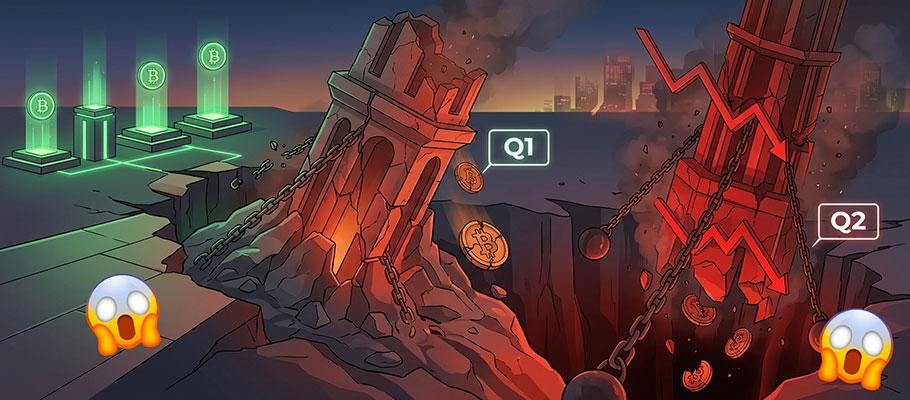
Bitcoin finished the final days of the second quarter on course for consecutive quarterly losses for the first time since the last major crypto bear market.
BTC ended June 2026 at just under $60,000, down roughly 12% across the quarter after losing 22% in the first three months of the year. A sell-off on June 26 pushed it to an intraday low of $58,115, its weakest level in around 20 months, before staging a slight recovery.
The decline reflects a convergence of forces. Spot Bitcoin exchange-traded funds recorded another $1.79 billion of net outflows last week, while the Federal Reserve's hawkish stance under Chair Kevin Warsh has kept interest-rate expectations elevated. At the same time, the US dollar has climbed to its strongest level in a year and investors have rotated towards semiconductor companies benefiting from the AI boom.
Bitcoin's weakness has infected the broader digital asset market. Ether has dropped about 25% during the quarter and lost nearly half over the past year. Dogecoin, XRP and Hyperliquid's HYPE token all suffered double-digit weekly declines. Solana has been more resilient but is still sharply lower over the past 12 months.
The question for investors is whether this marks the breakdown of Bitcoin's familiar four-year cycle or just a new painful chapter.
Bitcoin's market history has recurring rhythms. Traditionally, three years of gains have been followed by a single year of retrenchment. A second consecutive annual decline would challenge that pattern. It would also raise uncomfortable questions about how institutional adoption of crypto has fundamentally altered the market's behaviour.
Still, it may be too soon to declare the cycle broken. In the past, when Bitcoin recorded two consecutive negative six-month periods (most notably during 2018 and 2022), the event preceded an extended multi-year recovery.
Market sentiment looks deeply depressed. The widely followed Fear and Greed Index recently fell to 18, firmly within "Extreme Fear" territory. Readings like this typically coincide with periods when sellers have largely exhausted themselves.
But markets seldom repeat history exactly. Institutional ownership, the rise of regulated investment products and a far more mature derivatives market have all changed Bitcoin's structure since previous cycles. Historical analogies may be useful but they can't be treated as forecasts.
Few companies better illustrate Bitcoin's changing relationship with traditional finance than Strategy. The software company's shares and preferred securities have taken a beating as investors reassess the highly-leveraged corporate treasury strategy championed by executive chairman Michael Saylor.
Strategy's common stock fell 9.35% last week to $94.13 after touching an intraday 52-week low of $92.28. The decline leaves the shares dramatically below their recent peak above $450. Its dividend-paying preferred security, STRC, also slid to a fresh low near $81, well beneath its $100 par value.
Bitcoin recovered to around $61,000 after stronger-than-expected earnings from memory-chip manufacturer Micron Technology gave broader risk appetite a lift, but investors appeared unconvinced that fundraising alone can fix Strategy's structural bind.
The lower the firm's equity trades, the harder it becomes to issue new shares on attractive terms, limiting its ability to purchase additional Bitcoin or refinance obligations. While the company retains sufficient cash to cover debt servicing for many months, the market appears more focused on longer-term flexibility rather than near-term solvency.
Some investors argue the company should realise gains by selling part of its Bitcoin holdings and rebuilding its balance sheet. Others think large Bitcoin holders may benefit from sustained pressure on Strategy's financing model.
Crypto investors are also less optimistic about one of the sector's most anticipated policy developments.
Galaxy Digital has cut its estimate of the probability that the CLARITY Act becomes law during 2026 to 50%, continuing a steady series of downgrades from 75% in May.
The reassessment reflects legislative arithmetic rather than ideological opposition. The U.S. Senate has yet to produce unified legislative text or establish a firm timetable for debate before its lengthy August recess.
Competing priorities, including election legislation, defence measures and other domestic bills, have crowded an already congested congressional calendar.
Prediction markets like Kalshi are even more pessimistic, assigning the legislation less than an even chance of passage next year. Yet several industry observers argue that declining probabilities primarily reflect procedural delays rather than weakening political support.
While cryptocurrency prices struggle, another corner of the digital asset industry is making steadier progress.
Blackrock-backed Securitize announced plans to list on the New York Stock Exchange under the ticker SECZ, following its merger with a special purpose acquisition company backed by Cantor Fitzgerald.
The transaction moved closer to completion after fewer than 30% of shareholders elected to redeem their shares, allowing Securitize to retain roughly $400 million from the merger and associated private financing.
The listing is significant because of what it represents. Tokenization has been described as finance's inevitable future. Now public markets are ready to test whether investors agree.
Once regarded as an experimental blockchain application, tokenized securities now have backing from some of TradFi’s biggest players. BlackRock selected Securitize to administer its tokenized money market fund, while firms including Apollo Global Management, BNY, Hamilton Lane and KKR have also embraced aspects of tokenized finance.
Earlier this year, Securitize announced plans to work with the New York Stock Exchange on infrastructure for blockchain-native securities. The company says it now services more than $4 billion in tokenised assets, with BlackRock's BUIDL fund accounting for the largest share.
That's still small when compared to the scale of global capital markets. Yet tokenization echoes previous financial technologies that eventually became commonplace: gradual adoption that was largely invisible, driven by growth of institutional infrastructure rather than retail enthusiasm.
As cryptocurrency markets wrestle with cyclical pessimism, tokenization tells a different story. Beneath the volatility, parts of the industry's underlying plumbing continue to expand. The challenge for investors is working out which trend proves more durable.


