
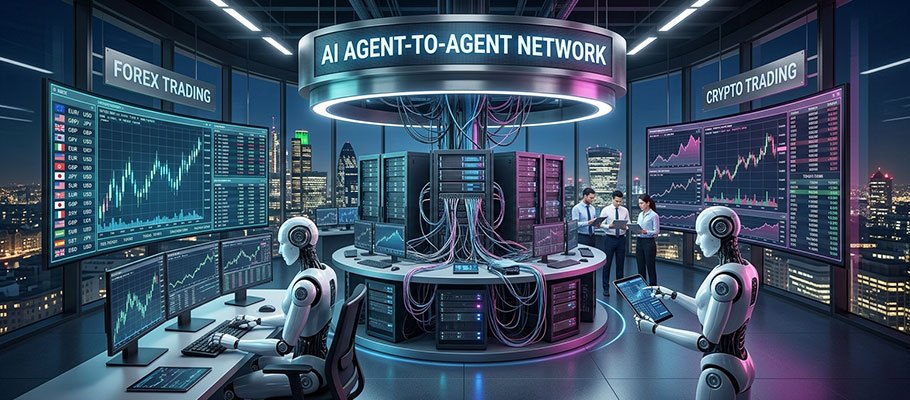
The advent of artificial intelligence into everyday human life is changing the way human beings live their lives. Work, study, vocations, play and virtually all aspects of living are now being impacted in some shape or form by artificial intelligence. One of the ways in which AI is creating impact in a manner never seen before is in the world of financial trading and financial transactions.
This article shows how the rise of AI agents has led to a new method of trading and transacting in the financial space: A2A or agent-to-agent interactions. Let's delve deeper into the topic.
Under the introduction, we will do the following:
A2A, or agent-to-agent interaction, describes a scenario in which systems built with an AI backbone go beyond basic human assistance to perform complex tasks such as communicating with other AI systems. Such communication can occur in various ways.
The idea of A2A gained serious momentum after Google launched its Agent2Agent protocol, designed to enhance interoperability between platforms by enabling AI agents from different vendors to discover one another, securely share information, and complete multi-step workflows. Agent payment standards, such as Google Cloud's AP2, are being developed to bypass human intervention and let AI agents handle the entire process of initiating transactions across cards, bank transfers, and stablecoin rails in a secure and compliant environment.
When it comes to financial markets, the shift from human to AI-agentic performance matters because they already have a heavy machine-driven, data-rich footprint. The sensitivity of price data to latency, which also exceeds the limits of human execution, has led to the development of algorithms that, by their very definition, are AI agents.
However, AI agents can go beyond what conventional algorithms cannot. Traditional trading systems follow predefined logic, AI agents go further by interpreting and sifting through unstructured information, deciding which counterparties to interact with, potentially delegating various subtasks to other AI agents, and producing an executable outcome.
For a conventional forex trader who has to deal with risk events that can produce very fast, volatile price moves that test the capacity of traditional systems with human involvement, the use of A2A systems can be a game-changer. A2A is highly relevant in financial markets and in arenas where interoperability, speed, and continuous decision-making are major success factors. The transition from algorithmic automation to agentic coordination is therefore quite natural.
The FX and crypto markets constitute the clearest early use cases for AI agents. The foreign exchange market is not centralized. Rather, it is fragmented across an entire value chain comprising banks, electronic communication networks (ECNs), non-bank liquidity providers, and various payment corridors. Crypto markets operate 24/7 across centralized and decentralized exchanges, on-chain arenas, and stablecoin networks. Both markets are constant sources of data comprising price, liquidity, news, and transactional data. In such an environment, AI agents can be used to actively participate in various functions within the value chain, such as analytics, monitoring, routing, reconciliation, and settlement.
What do A2S systems look like in the financial markets? To understand this, we need to look at the following:
Practically speaking, the use of A2A in financial markets means one AI agent can communicate with another AI agent to complete a segment of a trading workflow. For instance, an AI agent responsible for market-monitoring can detect an ongoing volatility shock, pass the event information to a macro-analysis AI agent for interpretation, and from there the results get sent to a third agent in charge of market execution to design the order (order type, asset, etc). A fourth agent in charge of risk management can be engaged in the process to filter the order according to the acceptable risk profile designed for the strategy and to adjust exposure limits. This is all done seamlessly and without the interference of human emotion.
The end-value is not only intelligence, but precise coordination. Available open A2A-style frameworks are designed precisely for this kind of multi-agent workflow, where price discovery, data exchange and task completion can be made to happen across several systems rather than within a single monolithic application.
Why does interoperability matter in financial trading? Interoperability enables the use of separate AI agents within a coordinated stack, increasing redundancy, improving resource use, and reducing the risk of a single point of failure. Rather than a single model doing everything (macro news trading, execution, risk management, compliance, and trade management), we can split these functions across several agents and simply establish the necessary bridges to enable them to pass work to one another in a secure environment.
Also, in a trading environment where speed is essential, having a system that creates faster decision-to-execution cycles is the way to go. The transition from risk event shock detection, interpretation, execution, and risk management can be handled by several agents, with information transmitted between them almost simultaneously.
Furthermore, multi-venue markets such as FX and crypto will benefit from interoperability, as it provides greater cross-market awareness. Because the FX market is fragmented and the crypto market is a continuous market that never closes, AI agents that can share information across systems and delegate tasks will be valuable for reducing missed opportunities and operational lags.
The FX and crypto markets are great testing grounds for A2A due to their fragmented, fast-moving nature. They are also heavily dependent on machine-readable infrastructure. FX's lack of a single centralized venue means pricing comes from various sources, and the quality of order execution varies from one counterparty to another. Furthermore, macroeconomic news can cause seismic shifts in order flows within seconds. This is the perfect ground for deploying AI agents, as there is a need to monitor multiple information sources, interact with various platforms, and make key decisions on how transactions are routed or exposure is managed.
The crypto market aligns even better with the AI agency model. It operates 24 hours a day, seven days a week. It has a robust presence of programmable assets such as stablecoins. An AI agent in the crypto space can continuously monitor metrics such as spreads, on-chain activity, wallet balances, and settlement costs. The time lag between trade analysis and transaction is shorter than in traditional finance, making the crypto market one of the clearest early use case environments for agentic AI deployment.
AI agents in the FX market are now being used for the following activities:
In FX, AI agents can monitor the markets by tracking key news headlines, geopolitical events, and macro releases. AI agents can perform execution support by evaluating liquidity conditions, slippage risk, and venue quality before routing orders.
AI agents can help trading desks monitor exposures and determine hedging requirements. Furthermore, AI agents can assist in liquidity management. According to research by the Bank for International Settlements, AI agents can assist in making real-time cash and liquidity decisions in payment systems, which can be critically relevant for FX operations.
In the crypto markets, AI agents are deployed in the following ways:
In exchange-based trading, AI agents can monitor multiple exchanges to perform tasks such as spread comparison, on-chain flow analysis, wallet rebalancing, and coordinating various trading tasks, such as order matching and execution.
The crypto market is gradually leaving the arena of speculation and is fast becoming a structured transactional marketplace. Stablecoins and modern payment stacks are transforming the crypto space into an environment not just for exchange-based trading, but also for AI agents to conduct monetary transfers, settle obligations, and rebalance treasury positions. A future in which AI agents control and manage transactions, with stablecoins integrated into mainstream payment and ecommerce channels, has already been predicted by credit card processors VISA and Mastercard.
Three forces are driving the increasing use of A2A in transactions and payments. First, open standards are gradually eroding the barriers that previously prevented interoperability. Secondly, financial institutions are now diving headlong into more operational, agentic AI and are no longer restricting themselves to experimental generative AI systems. Thirdly, payment and settlement infrastructure are gradually adopting programmable settlement systems, such as stablecoins. AI agents can initiate payment transactions. For instance, Google's AP2 is explicitly designed as a protocol for initiating and performing secure, compliant transactions between agents and merchants. It supports various payment channels, including bank wires, card payments, and stablecoins, and serves as a one-stop shop for fiat- and crypto-based payments. A few years ago, this would not have been thought possible as financial regulators and banks explicitly pushed back against any form of crypto-payment involvement on their platforms. Now, we have a major shift.
For FX and crypto, this is a powerful innovation and can give access to those who were previously locked out of these markets due to geographical inaccessibility to conventional payment systems. A crypto treasury agent can automatically rebalance stablecoins across various venues, settle counterparties, and reconcile in-house ledgers.
► Benefits
There are several benefits associated with the rise of A2A in financial markets. Speed is the first one. Direct coordination between AI agents reduces delays between information arrival and the corresponding response. In markets where price conditions and liquidity can change suddenly, such as FX and crypto, this makes a world of difference.
Then there is the benefit of operational efficiency. A2A architecture helps bind together the various layers of fragmentation that exist in traditional financial market workflows, thereby making the processes more efficient.
The third benefit is the 24/7 coverage that AI agents can provide, especially in the crypto market, which also runs 24/7. It is also valuable in the cross-border payments arena and in managing global FX risks. Across the London, New York, and Asian time zones, there is a need to harmonize activities. While humans cannot, AI agents can because they do not sleep.
Finally, A2A systems allow firms to combine market and payment data, risk policies, and settlement logic into a single coordinated process, thereby improving decision quality.
► Risks
Despite the promising utility of A2A systems, there are also risks. For instance, a model risk can arise if the AI agent misunderstands a macro event or routes activity in a way that proves commercially damaging, even if the logic seems correct.
Another risk stems from behavioural correlations and typically arises when a firm relies on agents who are similarly trained. This could create a scenario in which they all produce similar responses to the same signals, amplifying volatility. Some of this crowding behaviour already exists in regular algorithmic markets, but interconnected, autonomous AI agents can amplify it.
Then there are security and governance concerns. If A2A agents handle payments or initiate trades, the firms that use them must ensure that the agents in question have undergone proper authorization, are authentic, and are subject to periodic audits. The payments and trading environments are arenas where a much higher bar for trust and controls is required, and AI agents operating in these spaces must meet these standards.
As with the entire AI ecosystem, the issue of regulation remains unresolved. The financial markets are strictly regulated, but the supervisory mechanisms for AI systems are yet to be clearly delineated. When using largely unregulated tools in regulated environments (payments, market execution, and treasury), there will be questions about controls, human accountability, and explainability. It is hard to believe that financial regulators will allow such A2A systems to operate with no constraints whatsoever. Any permissions and exceptions will have to be worked out over time.
The use of AI agents in finance and trading to power the new A2A systems will have implications for traders, brokers/exchanges, banks/treasury desks and compliance teams.
For traders, A2A brings a future where the trading edge is not derived from access to raw information but more from the quality of the AI agent stack deployed. Traders who can use AI agents to merge macro event interpretation to sentiment analysis, proper routing logic and risk control are more likely to get faster and more accurate trade responses than those who rely solely on manual analysis. The most immediate impact is the augmentation, not the replacement, of the decision-making process in trading.
For brokers/exchanges, the opportunity lies in the infrastructure. Brokers and exchanges that deploy agent-friendly APIs, real-time reporting, and improved routing logic within highly secure authorization frameworks will be the brokers of choice for the future. In the crypto market, additional infrastructure includes agent-ready wallets and machine-based settlement services. In the FX market, the advantage lies in treasury integration and more adaptive execution logic.
For banks and payment firms, there is a much broader use case for A2A. Compliance, liquidity management, treasury operations, cross-border settlement, and client servicing are all potential areas where A2A can find wide deployment. In the future, financial institutions will have to transition to a world where AI agents are part of their daily workflow.
In conclusion, the rise of A2A (agent-to-agent) is not hype. The FX and crypto markets are early testing grounds due to their fragmented nature and increasing reliance on digital infrastructure.
The rise of A2A in financial markets is the next frontier of financial digitization. The finance and trading industry is shifting away from isolated tools toward networks of specialized AI agents that can harmonize previously isolated workflows.
Those who become the big winners with agentic AI in trading and transactions are those who combine the agentic AI advantage with human trust and supervision.


