

While artificial intelligence (AI) won't magically predict your favorite instruments, it will do one thing: systematize your edge by providing you with faster research and more disciplined execution, using much cleaner data. If you are an ambitious FX trader operating in the retail space, now is the time to up your game and put that edge to your trading once and for all.
The failure of most FX retail traders to remain profitable on a consistent basis is not due to a lack of trading ideas or strategies. It is simply due to inconsistency in their process. One day, they trade with the news, and on another, they skip the news filters altogether. Setting of stops and target prices for their trades follows no pattern. Then comes the impact of emotions: targets and stops are adjusted, revenge trading occurs and very little goes into actually developing a consistent methodology for trading.
If you see yourself in the picture painted above, then this is for you. You can leverage the power of AI to transform the disorderliness and discretionary chaos that exists in your methodology, into a repeatable, testable workflow that stands the test of time.
When you set about building an AI trading tool in the retail forex space, there are certain layer stacks that must be handled. These are as follows:
How do you want your AI robot to execute the signals it generates? This will depend on the trading software that you will use, and will also need to accommodate such information as risk per trade, stops and targets, and any other filters such as session or time filters. You may also want the AI robot to only execute a certain number of trades. This can come in handy if you are trying to pass a prop firm challenge and do not want to violate the daily trailing loss limit. For executions, you may opt to develop an AI robot for the MT4 and MT5 platforms, which utilize the MQL or C# code to function, or you may opt to use the Python language to create an execution bridge.
Trade journaling must not be neglected. Ensure that the AI robot also has the capacity to log every trade automatically, noting such features as entry and exit prices, the spread, slippage (if any) and reasons for entry and exit. When you are creating prompts for the AI robot's creation, include this component as part of the build.
Due to the level of dynamism in the FX market, there is a need to introduce a level of governance into your AI robot's operations. For instance, there may be a need to conduct a periodic retraining of the AI trading tool, and perhaps introduce some form of kill-switch parameters when the performance of the bot starts to drop off.
When you are building an AI trading tool, there are some workflows you can implement into its logic. These are as follows:
What is the objective of signal scoring? The objective here is to form a filter for the signal using the price information. The AI trading tool should be able to label potential candidate bars as trade/no trade.
A) Inputs/Outputs: you should build some input data such as the session hour, ATR percentile for target setting, the wick/body size ratios, range compression, prior session trend, proximity of the signal price to the previous highs and lows (or resistance and support), etc. The input should lead to a corresponding output which grades the quality of the signal. You can have three grades; high quality, moderate quality, low quality.
B) Use: Once you have your output, the tool should then take only signals with an output probability you have defined for each asset.
What is the objective of sizing your positions according to the volatility profile of the asset being traded? This enables the tool to set a reasonable stop loss or profit target within the allowable limits of volatility. Tight stops in a highly volatile market will lead to many trades being stopped out. But at the same time, the tool should not set wide stops that can jeopardize risk management just to be able to accommodate volatility. A reasonable stop distance is around 0.8–1.2× of the predicted ATR, even as the risk on the account should not exceed 1%.
What is the objective of setting news filters? The objective is to create a map of all upcoming Tier-1 and Tier-2 news releases. These news releases could skew the robot's performance if there is a market surprise from the data. Mark these events as “surprise/no surprise”, and filter out any trade activity from the robot if there is a surprise. Implementing the news filter will block all new entries around the Tier-1 events marked as a surprise. You may also decide to water down the positioning of the robot to the barest minimum, especially if the news comes out in the direction of the robot's original trade idea.
What is the objective of regime detection? It is simply to identify ahead of time, days that could produce chaotic price action and choppy price movements, which could end up skewing your robot's performance.
Usage: If your robot is based on a breakout system, configure it to work in trending market situations. Otherwise, it can be taught to stand aside if the asset is whipsawing.
What is the objective of optimizing executions? Your AI trading tool needs to learn what entry and exit types work best on certain pairs or in certain trading sessions. For entries, would a market order or limit/stop order work best on an asset in London trading, or would a time-based exit work better versus fixed target trading stops?
Concept: The London Breakout strategy aims to capture the break of the Asian range, with a potential for a liquidity sweep before the release of the “overnight spring” (the breakout). The trade is set up with a limit order to catch the breakout move, with a stop loss set on the opposite side of the range. This is as shown on the chart below:
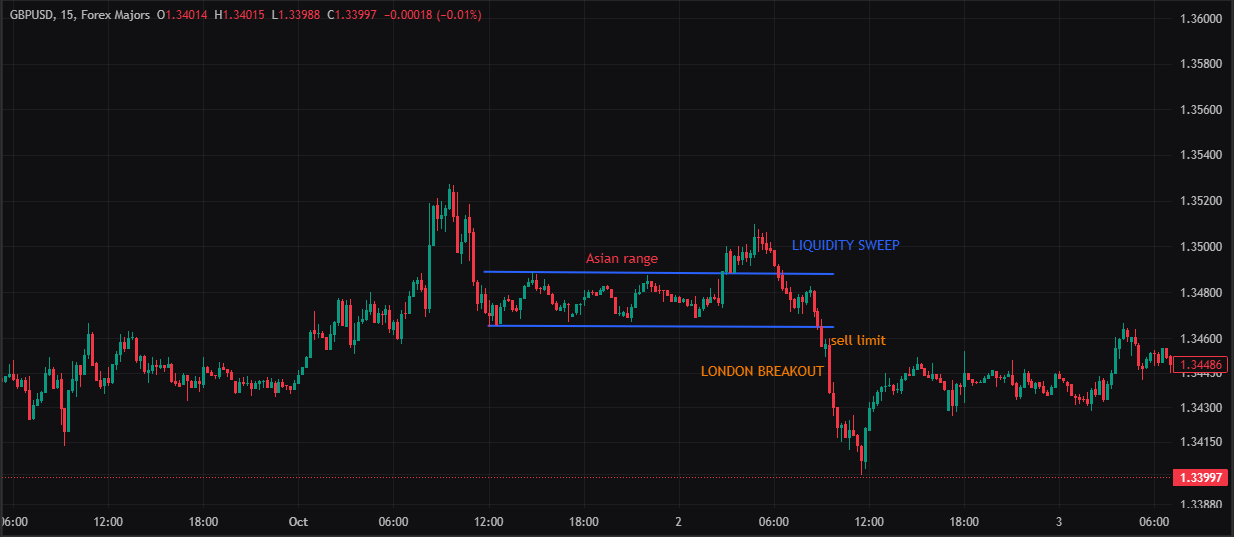
This strategy may look easy on paper, but it is a difficult one to execute. First, spotting the Asian range is one thing. Secondly, trying not to get caught out by the liquidity sweep (i.e. not mistaking it for the breakout) can be a challenge. This is where you need to pull out the stops to create an AI trading bot that can catch such setups and trade it profitably time after time.
How would you go about this? First of all, you need to create the add-ons to the AI tool:


