

Published: April 30th, 2026
The USDCHF price continued to push lower as bears became interested following the FOMC meeting. For the first time since October 1992, the FOMC (Federal Open Market Committee) voted 8–4 on Wednesday to maintain interest rates in the 3.5%–3.75% range.
Morgan Stanley has changed its forecast to anticipate no adjustments until year-end, after previously predicting two 25-basis-point Fed rate cuts in September and December. The company cites recent data showing economic resiliency and consistently high inflation as the main justifications for the change.
The need for safe havens helps the US dollar outperform its major rivals, but not after the FOMC meeting. US President Donald Trump rejected efforts to reopen important lines and prioritised economic pressure above military action.
On the other hand, Swiss Survey Expectations rose to -30.3 in April from a six-month low of -35.0 in March, according to ZEW data. Over half of those surveyed think things will stay the same over the next six months, while just over one-third expect them to get worse.
Let's see the further outlook from the USDCHF technical analysis:
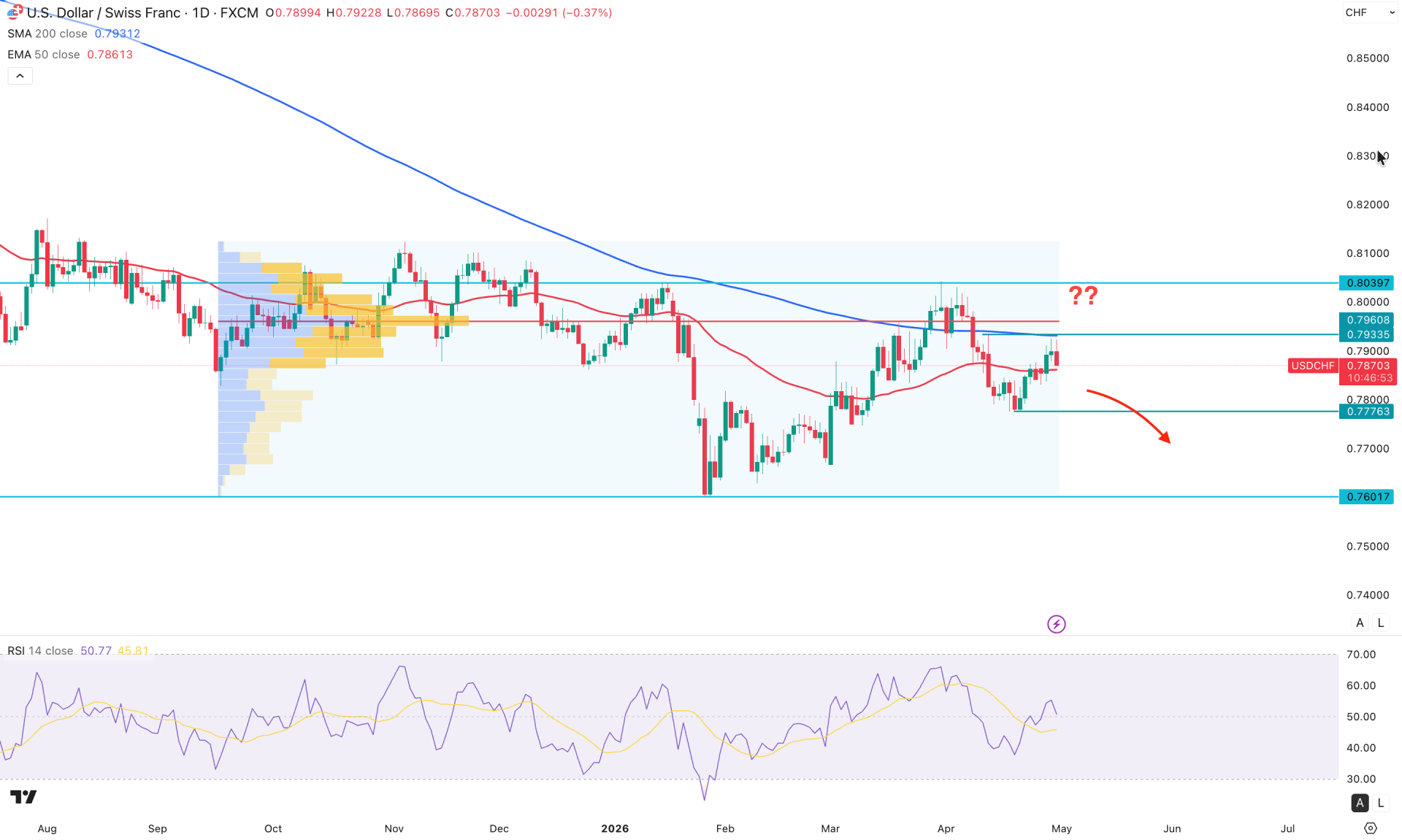
In the daily chart of USDCHF, a corrective bearish momentum from the double-top breakout. Primarily, the major market momentum is bearish, as higher dynamic lines are above the current price, signaling a continuation opportunity.
Looking at the higher timeframe, the price is trading at an extreme discounted zone, as multiple indecision candles are visible at the yearly bottom. Moreover, the latest monthly candle has closed as a bullish engulfing bar, suggesting minor buying pressure from the bottom. However, proper validation is needed, as the price remains below the crucial monthly resistance at 0.8039.
In terms of volume, sellers remain favorable, as activity has been at its highest since October 2025 and is above the current price. Primarily, as long as the price remains below the 0.7960 high-volume resistance line, the primary anticipation would be to open only short trades.
On the daily chart, the 200-day SMA is above the current price and serves as resistance at the 0.7933 static line. Primarily, the price is facing a confluence of resistance at that level, which signals a strong barrier to buyers.
On the other hand, the 50-day EMA is just in line with the current price, and the existing price action is above it. It is a minor barrier to sellers, as a valid break below this dynamic line is needed before extending the downside pressure.
The Relative Strength Index (RSI) shows a neutral momentum, as the current RSI level is at the 50.00 neutral level.
Based on the overall market structure, a failure to hold the price above the 50-day EMA could be a potential short opportunity, where the immediate target is the 0.7776 level. Moreover, a break below this line could open room for testing the 0.7601 key support level.
On the other hand, the entire structure is bearish, so bullish signals are needed before anticipating a buy move. Primarily, the 0.7933 resistance level is a crucial point to look at, which needs to be overcome before testing the 0.8039 resistance level. However, the long-term signal might appear after overcoming the 0.7960 high-volume resistance level with consolidation. The immediate resistance is at 0.8039, which needs to be overcome before moving beyond the 0.8300 area.
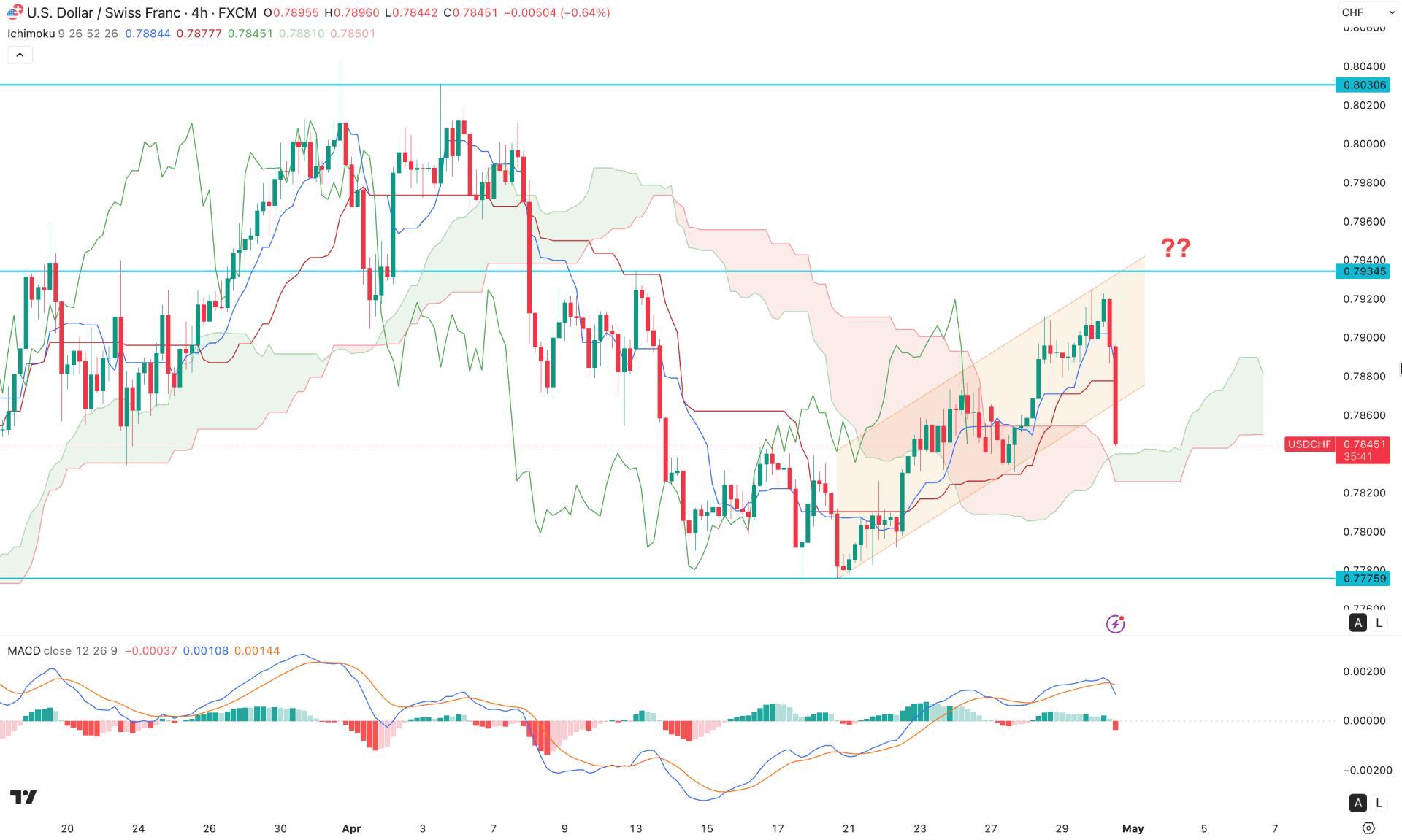
In the four-hour timeframe, the USDCHF chart shows a corrective bullish breakout above the cloud support, suggesting a minor bullish correction. However, immediate selling pressure is seen at the top, creating an ascending channel break, which has limited the upside opportunity.
In the indicator window, the price is facing selling pressure just above the Kumo cloud area, suggesting pressure on buyers. However, the future cloud is still solid for buyers, as both lines are heading upward.
The indicator window shows a different story, as a bearish rebound is visible at the MACD signal line. Moreover, the histogram has flipped to the bearish zone for the first time in a week.
Based on this outlook, investors should closely monitor how buyers hold the market momentum at the cloud support. Any bullish rebound with a four-hour close above the Kijun line could offer a high-probability long opportunity targeting the 0.8030 key resistance level.
However, corrective pressure could come after losing the 0.7820 cloud support low. In that case, the price can test the 0.7775 support level before making a new swing low.
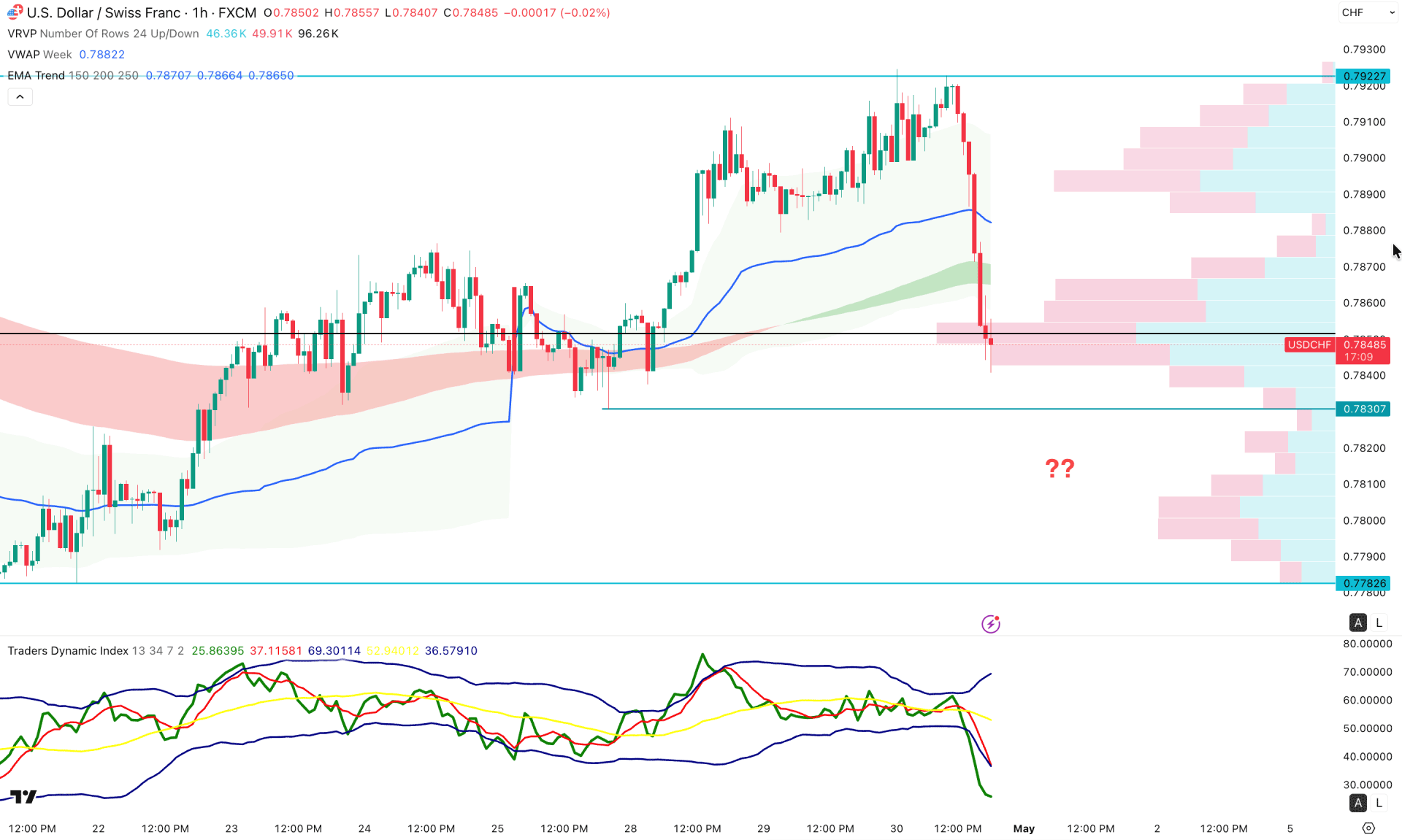
In the hourly chart, the USDCHF price is trading with extreme bearish pressure after forming a top at the 0.7924 level. As seven consecutive bearish candles are present from the top, a considerable bullish correction is pending.
The extreme downside pressure has pushed the price below the EMA cloud and reached the immediate support level at the 0.7851 level. As the current price is hovering at the high-volume support area, a valid bullish rebound could increase short-term opportunities.
On the other hand, the Traders Dynamic Index (TDI) is in an extreme bearish condition, as the most recent line has become flat at the lower peak level. It is a sign of extreme ongoing bearish pressure that may pause before making another bearish wave.
Based on the overall market structure, USDCHF is trading within a long-term bearish trend, where the intraday price is extremely bearish. In that case, a minor bullish correction is pending in the intraday chart, and any valid rejection from the near-term resistance level could offer a bearish trend continuation signal.


