

Published: July 9th, 2026
A hawkish interest-rate increase by the Reserve Bank of New Zealand (RBNZ) causes the New Zealand Dollar (NZD) to appreciate against the basket of currencies.
This week, the RBNZ increased its Official Cash Rate (OCR) by 25 bps, from 2.25% to 2.50%, as was generally anticipated. As policymakers sought to ensure inflation returns to target despite softening energy costs and an economy only slowly regaining speed, the central bank hinted that further tightening might be required.
The gain for the China-proxy Kiwi, however, may be limited by worse Chinese inflation figures. The Consumer Price Index (CPI) increased by 1.0% in June, down from 1.2% in May, according to data released by China's National Bureau of Statistics on Thursday. This number was less than the 1.1% market consensus.
Chinese CPI inflation came in at -0.3% MoM in June, down from a 0.1% decrease the previous month, less than the anticipated 0.2% decline.
According to the Guardian, the US has resumed its operations against Iran for the second day in a row, which has led to Iranian airstrikes on Bahrain and Kuwait in the most recent escalation to thwart attempts to stop the conflict. After stating that he believed the ceasefire was "over", President of the United States Donald Trump warned that strikes would "get much worse" if Tehran targeted vessels in the strait once more.
Iran's senior negotiator, meanwhile, declared that the strait "will only open with Iranian arrangements, not American threats" and threatened to fight against attacks. Growing hostilities in the Middle East may strengthen a safe-haven currency like the US dollar and pose a short-term threat to the pair.
Can NZD hold the gain against the US Dollar during this volatile condition? Let's see the complete outlook from the NZDUSD technical analysis:
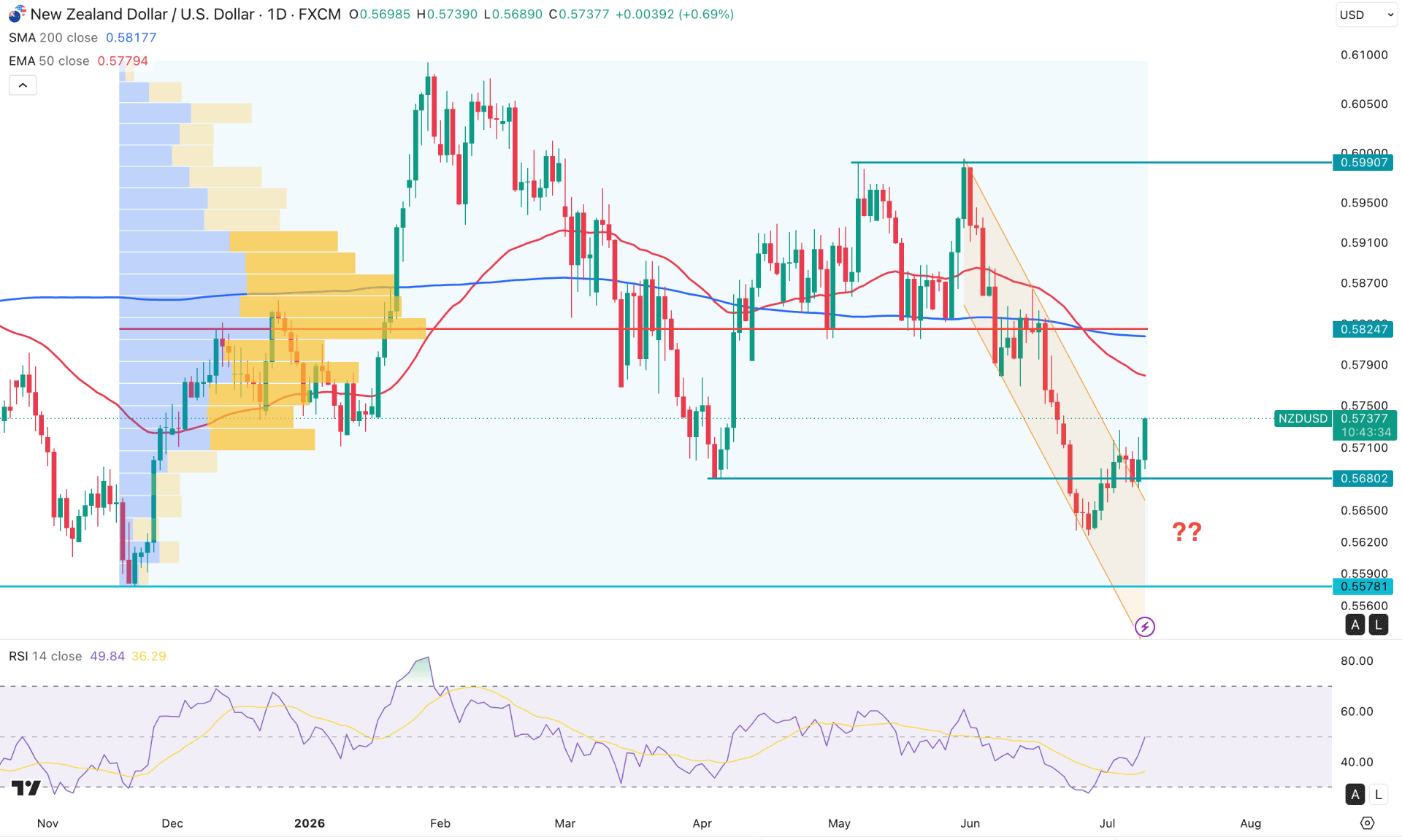
In the daily chart of NZDUSD, a broader outlook is bullish as the most recent price has rebounded from a crucial low. As the bullish rebound is solid with a counter-bullish momentum, more upside continuation is possible.
In the higher timeframe, a long consolidation is visible as the price keeps ranging in the monthly chart since the beginning of 2025. The running monthly candle is slightly bullish after a strong bearish month that eliminated the gain in early 2026. As long as the current price holds the buying pressure above the monthly flip zone, corrective bullish pressure is possible. The weekly timeframe also shows a minor bullish rebound possibility as the price reached the range bottom.
In terms of volume, sellers are still dominating the price as the largest activity level since November 2025 is at the 0.5824 level, which is above the current price. Moreover, the 200-day SMA and 50-day EMA are above the current price with a crossover bar signaling a death cross continuation.
On the other hand, the gap between the current price and the flat 200-day SMA signals a pending bullish correction as a mean reversion. The Relative Strength Index also supports the bullish possibility as the current line is hovering at the 50.00 area after having a rebound from the 30.00 oversold zone.
Based on the current market structure, NZDUSD is trading within a broader bearish trend, from where a minor bullish correction is pending towards the 200-day SMA. As the price rebounded above the 0.5680 existing low, there is a higher possibility of testing the 0.5824 high-volume resistance level before extending the downside pressure.
On the other hand, any immediate bearish move with a daily close below the 0.5680 level could open a highly probable short opportunity targeting the 0.5570 area.
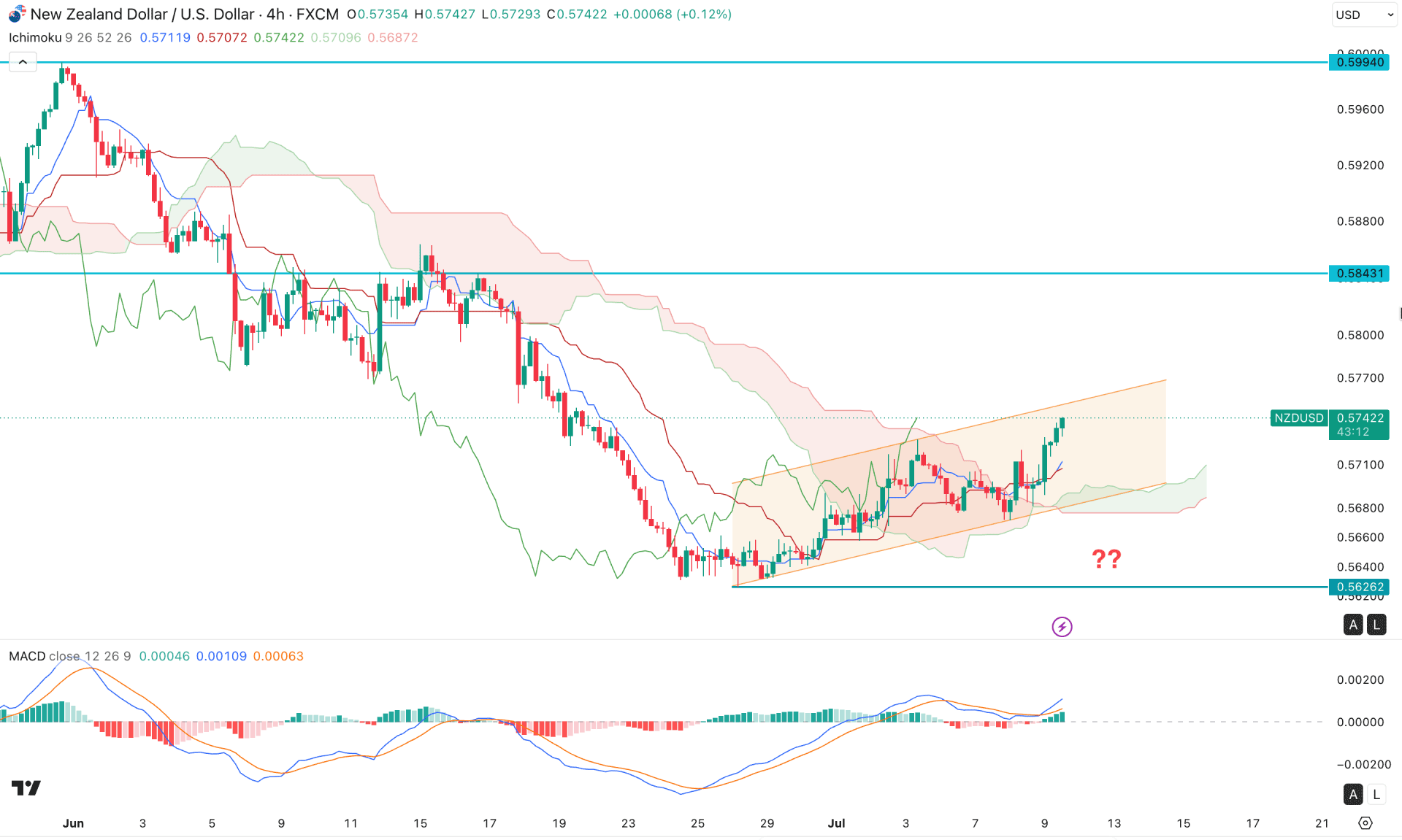
In the H4 timeframe, active downside pressure is visible, even if the recent price trades above the cloud area. The future cloud is supporting the buying pressure along with dynamic lines, which are just below the current price. However, the price is forming an initial wave above the Kumo cloud, which needs a proper retest before confirming the trend change.
In the secondary indicator window, the MACD signal line is at the bullish peak, signalling ongoing buying pressure. The histogram supports the momentum by continuing to move higher in the positive area.
Based on this market outlook, the price is above the Kumo cloud area with a bullish reversal from the key support level. As bullish momentum is within an ascending channel, the price is likely to test the channel resistance before confirming the trend. On the bearish side, a valid break below the 0.5680 level would validate the channel breakout and test the 0.5626 low.
On the bullish side, the upward continuation is valid as long as the price remains above the cloud support. The immediate resistance to look at is the 0.5843 level, and overcoming this line could take the price beyond the 0.5994 area.
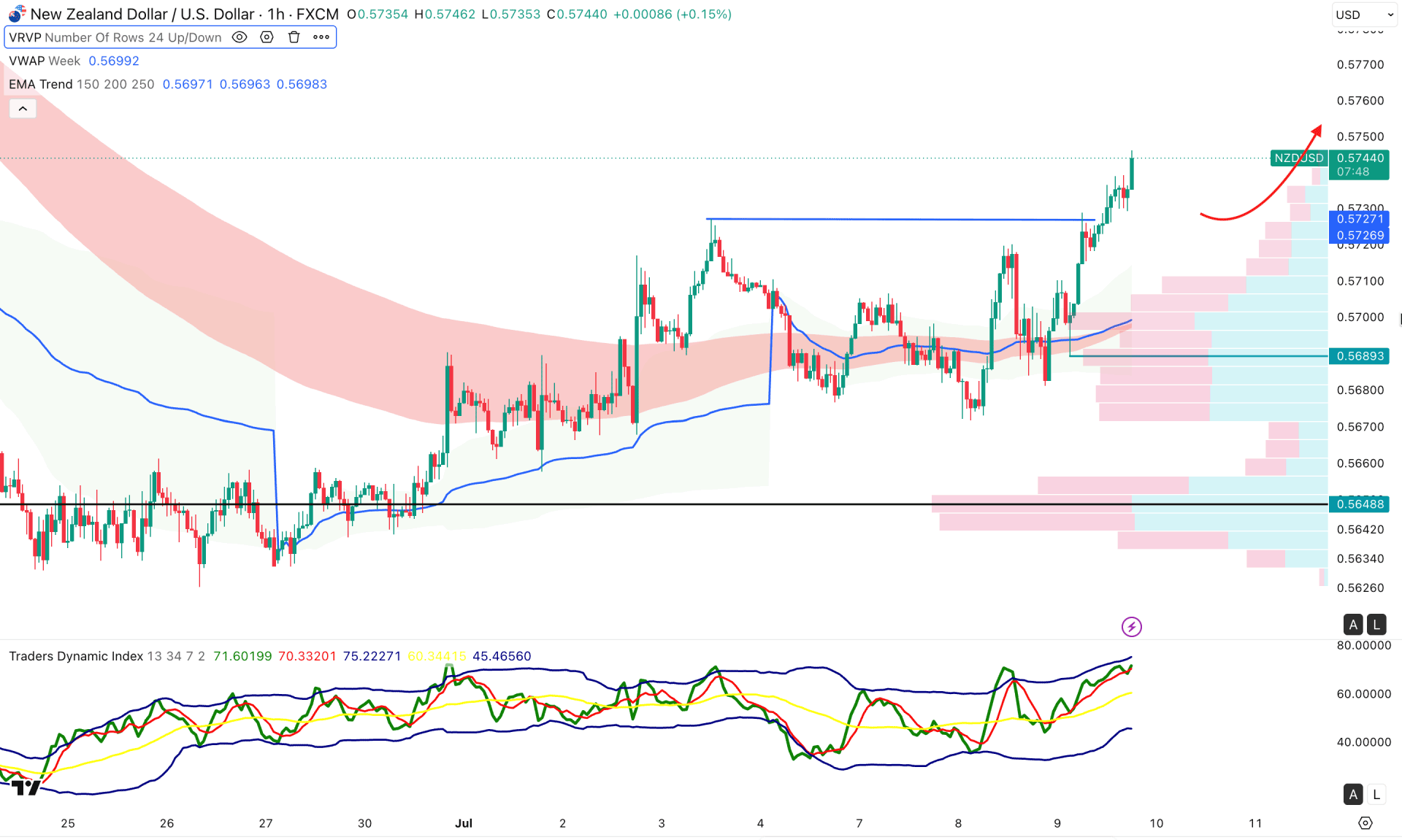
In the hourly timeframe, NZDUSD price is trading at the intraday high, signalling ongoing buying pressure. The momentum is supported by a valid breakout and retest at the weekly VWAP support. However, the ongoing price action is in an extreme bullish zone from where considerable downside pressure could come.
In the hourly chart, the weekly VWAP and EMA waves are closer together, having a rebound near the 0.5689 key support level. Moreover, the intraday high volume line is below this level and is working as a major barrier to sellers.
Based on this outlook, a downside correction is possible as long as the price remains in an extreme bullish zone. The gap between the price and the dynamic weekly VWAP has expanded, creating a downside possibility.
In this case, a failure to hold the price above the 0.5727 swing high could initiate a bearish opportunity targeting the 0.5689 support level.
Moreover, a failure to hold the price above the weekly VWAP level signals further downside pressure targeting the 0.5648 high volume area.
Based on the overall market structure, NZDUSD is still trading within a bearish trend, from where the recent bullish rebound signals a possible bullish correction at the 50% Fibonacci retracement level of the existing daily swing. The intraday price is extremely bullish, with a pending downside correction to validate the long opportunity.


